Nikon Monarch M5 8x42 vs Celestron TrailSeeker ED 8x42
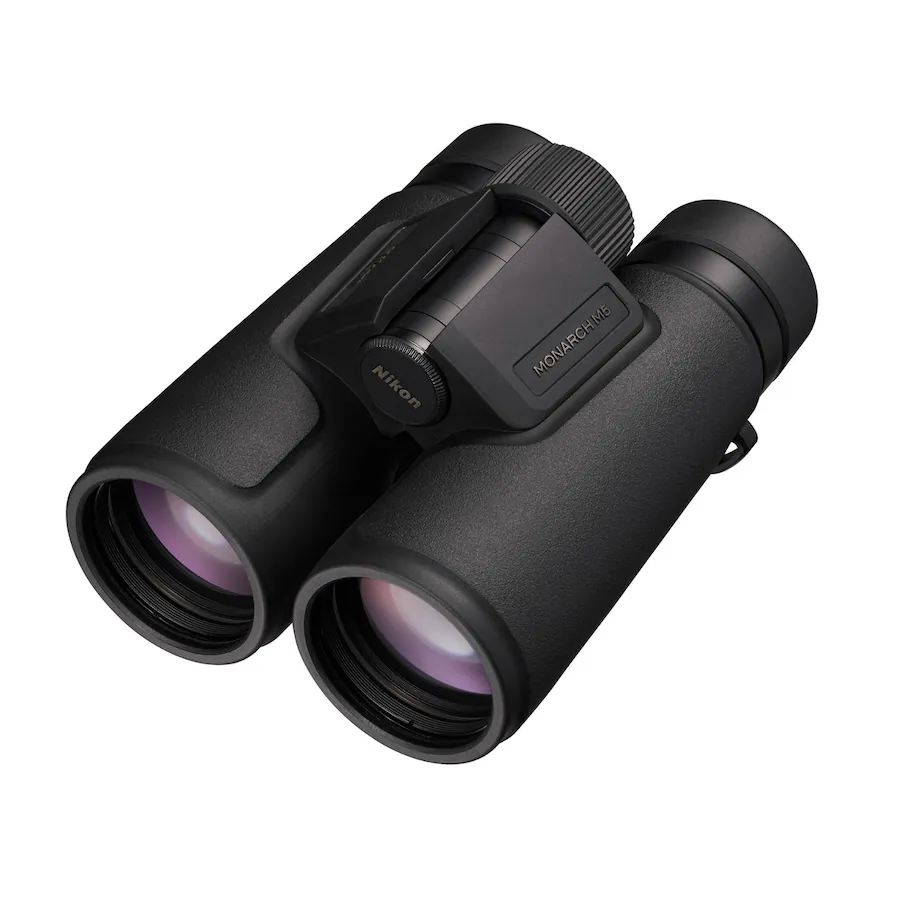
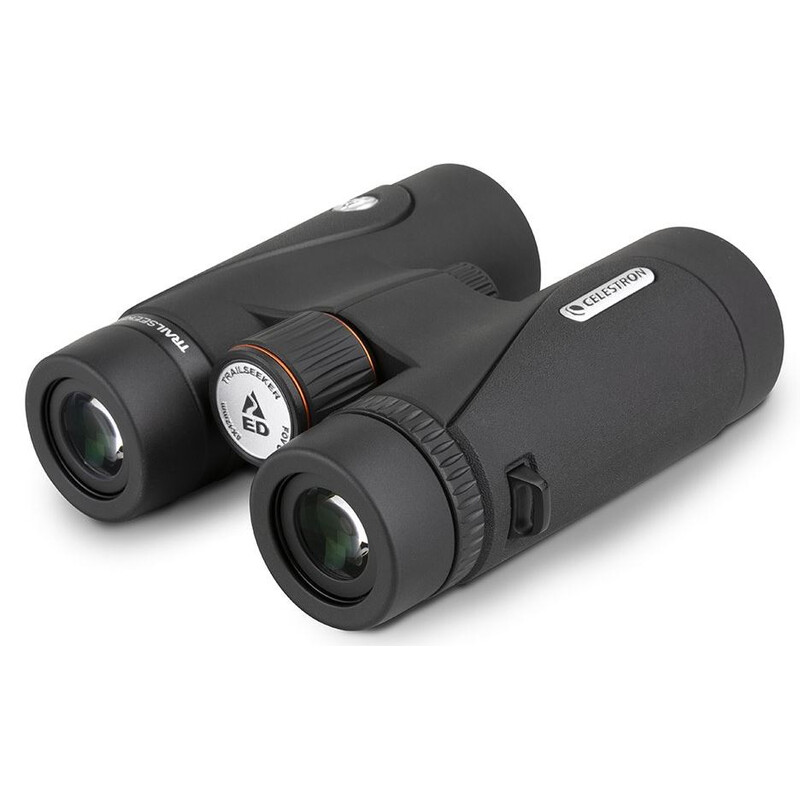
Quick take: The Celestron TrailSeeker ED 8x42 has a wider field of view (426 vs 335 ft @ 1000 yds).
Field of view, to scale
Top-down view · drawn to true scale — no exaggeration
Which one to buy
Same $340, same 8x42 format, both with ED glass, dielectric prism coatings and a limited lifetime warranty. The Celestron TrailSeeker ED 8x42 then pulls clearly ahead on the one spec Nikon Monarch M5 8x42 owners complain about most: field of view. The Celestron shows 426 ft at 1000 yards; the Nikon 335 ft, and its owners describe a tunnel-vision feel that makes warblers in the canopy hard to follow.
The Celestron's owners back up the numbers. They describe minimal color fringing, brightness that punches well above the price, a buttery metal focus wheel and a magnesium chassis with metal eyepiece housings. It also focuses closer, at 6.5 ft against 8.2 ft. Its complaints: it starts to struggle at early dawn and late dusk, the diopter does not lock and can wander in a bag, edges soften at the far reaches of that big field, and the case feels cheap.
The Nikon's strengths are a very bright, sharp center, a dense build with a long durability record, a locking diopter, 19.5mm of eye relief against the Celestron's 17.2mm, and dawn and dusk performance hunters praise. Its owners also mention soft edges, some fringing in harsh light, rolling-ball distortion for a sensitive few and occasional sample variation in focus snap.
For birding, the TrailSeeker ED is the better buy: the wider view changes how easily you find birds, and nothing on the Nikon makes up for it. The Monarch M5 suits hunters and deliberate observers who study a still subject, wear glasses, or glass at the last light of the day.
Nikon Monarch M5 8x42
For whitetail hunters and glasses wearers who study a subject rather than chase it, the sharp center and long eye relief suit best.
Celestron TrailSeeker ED 8x42
Best for birders: the much wider view, closer focus and metal build make it the stronger 8x42 at this price.
| Spec | Nikon Monarch M5 8x42 | Celestron TrailSeeker ED 8x42 |
|---|---|---|
| Approx. price | ~$340 | ~$340 |
| Use case | Birding | Birding |
| Magnification | 8x | 8x |
| Objective | 42mm | 42mm |
| Exit pupil | 5.25mm | 5.25mm |
| Field of view | 335 ft @ 1000 yds | 426 ft @ 1000 yds |
| Eye relief | 19.5mm | 17.2mm |
| Close focus | 8.2 ft | 6.5 ft |
| Prism | Roof | Roof |
| Glass | ED | ED |
| Coating | Fully Multi-Coated | Fully Multi-Coated |
| Weight | 22.2 oz | 23.5 oz |
| Dimensions | 5.5 x 5.1 in | 5.5 x 4.9 in |
| Warranty | Limited Lifetime | Limited Lifetime |
Feature comparison
Nikon Monarch M5 8x42
- ✓ED Glass
- ✓Phase-Corrected
- ✓Dielectric Coating
- ✓Waterproof
- ✓Fogproof
- ✗Image Stabilized
- ✓Tripod Adaptable
- ✗Magnesium Body
- ✓Locking Diopter
Celestron TrailSeeker ED 8x42
- ✓ED Glass
- ✓Phase-Corrected
- ✓Dielectric Coating
- ✓Waterproof
- ✓Fogproof
- ✗Image Stabilized
- ✓Tripod Adaptable
- ✓Magnesium Body
- ✗Locking Diopter
What birders say
Nikon Monarch M5 8x42
- ✓ED glass at $250 delivers noticeably cleaner high-contrast edges than the Prostaff line - fringing on backlit birds is well controlled
- ✓Very bright, sharp central image - reviewers and owners consistently rate the sweet-spot resolution among the best under $300
- ✓Continues the legendary Monarch 5 lineage - a track record of durability that long-time users measure in decades
- ✓Excellent build quality with a solid, dense feel that owners contrast favorably against the plastickier Prostaff bodies
- ✓Long eye relief (about 19.5mm) with firm click-stop eyecups makes it reliably comfortable for eyeglass wearers
- ✓Fully waterproof and fogproof with a proven armor that survives real hunting abuse
- ✓Fast, precise focus with a well-weighted wheel - a clear step up from the Prostaff P7's inconsistent focuser
- ✓Strong dawn/dusk performance thanks to dielectric prism coatings plus ED glass - a favorite among whitetail hunters
- ✗Narrow 6.3-degree field of view (335 ft) is the single biggest owner complaint - birders describe a 'tunnel vision' feel versus the M7 or P7
- ✗The tight FOV makes finding and following warblers in canopy genuinely harder for beginners
- ✗Rolling-ball distortion when panning bothers a minority of sensitive users - a few report mild nausea while scanning
- ✗Edges of the field go soft, so the excellent center sharpness doesn't extend far
- ✗Some chromatic aberration still visible in harsh bright-light conditions despite the ED glass
- ✗At $250 it faces brutal competition - the Monarch M7's much wider field costs only modestly more
- ✗Included case and strap are serviceable but underwhelming for the price tier
- ✗A few owners report sample variation in fine-focus snap - worth testing your unit critically on distant detail
Celestron TrailSeeker ED 8x42
- ✓Repeatedly called one of the best values in binoculars, period - owners say things like 'you'd have a hard time convincing me there's a better value out there' and that there's no point paying more for other brands at this level
- ✓Genuinely wide 426 ft field of view - one of the widest of any 8x42 at any price, which makes scanning tree canopies and tracking birds in flight noticeably easier than the ~330-380 ft typical of competitors
- ✓ED glass actually does its job here - color fringing is minimal and rated among the best in class by expert reviewers, a real step up over the non-ED TrailSeeker and the Nature DX
- ✓Brightness that punches way above its price - in low-light testing it beat the mid-range benchmark and hung close to alpha-level glass, unusual for a sub-$300 binocular
- ✓Magnesium alloy chassis and metal eyepiece housings at a price point where most competitors (Vortex Diamondback, Nikon Monarch 5) use polycarbonate
- ✓Metal focus wheel with smooth, quick action that owners describe as 'buttery' - images snap into focus rather than requiring hunting
- ✓6.5 ft close focus is excellent for an 8x42, good enough for butterflies and dragonflies at your feet
- ✓17.2mm eye relief with twist-up eyecups lets eyeglass wearers see the full wide field - a common sticking point with budget binoculars that this one gets right
- ✗Low light is where it finally shows its price - reviewers note it starts to struggle at early dawn and late dusk, so dedicated crepuscular birders may want to spend up
- ✗The diopter ring has no locking mechanism and only a modest ±3 adjustment range, so it can get knocked out of position in a bag
- ✗Slightly heavier in the hand than some owners expected given the compact size - the magnesium build is dense at 23.5 oz
- ✗The included carry case took a step down from older Celestron cases - functional but cheap-feeling, and the accessories overall are unremarkable
- ✗Edge softness is present at the extreme edges of that huge field of view - the sweet spot is generous but it's not flat-field glass like a Nikon Monarch HG
- ✗Some forum members rank its field of view and close focus behind certain similarly-priced rivals depending on sample, so trying before buying is worth it
- ✗Celestron's 'Limited Lifetime' warranty is not the no-fault, no-receipt VIP-style coverage Vortex offers on the Diamondback - damage from accidents isn't covered
- ✗Brand snobbery is real - some birders on forums admit they'd rather carry a Nikon or Vortex badge, and resale value reflects that even when the optics compete
Nikon Monarch M5 8x42 vs Celestron TrailSeeker ED 8x42: common questions
How much wider is the Celestron TrailSeeker ED 8x42's view than the Nikon Monarch M5 8x42's?▾
The Celestron shows 426 ft at 1000 yards against the Nikon's 335 ft. Monarch M5 owners call its narrow field their single biggest complaint, while TrailSeeker owners say the wide field makes scanning canopies and tracking birds in flight noticeably easier.
Is the Nikon Monarch M5 8x42 better than the Celestron TrailSeeker ED 8x42 at dawn and dusk?▾
Owners suggest it may be. Hunters praise the M5's dawn and dusk performance, while TrailSeeker owners say theirs starts to struggle at early dawn and late dusk. Both have the same 5.25mm exit pupil, so the difference is modest.
Which is better for eyeglass wearers, the Nikon Monarch M5 8x42 or the Celestron TrailSeeker ED 8x42?▾
Both work. The Nikon offers 19.5mm of eye relief with firm click-stop eyecups, and the Celestron 17.2mm, which its owners say still shows the full wide field with eyecups down. The Nikon has more margin for thick lenses.