Fujinon Techno-Stabi TS-X 14x40 vs Fujinon Polaris 7x50 FMTR-SX
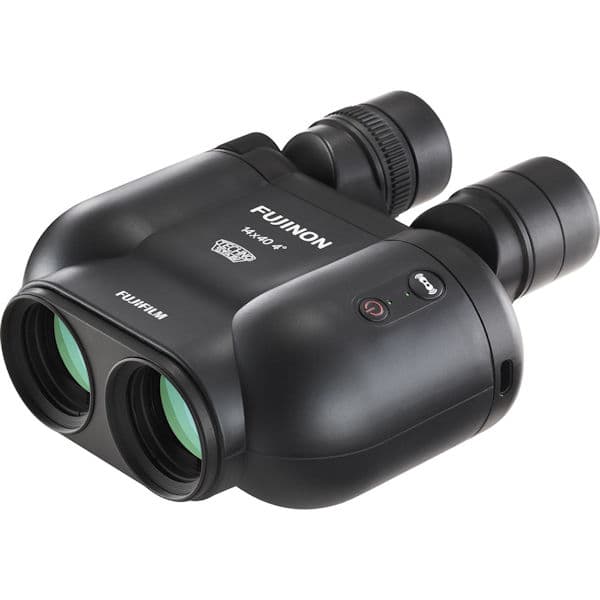
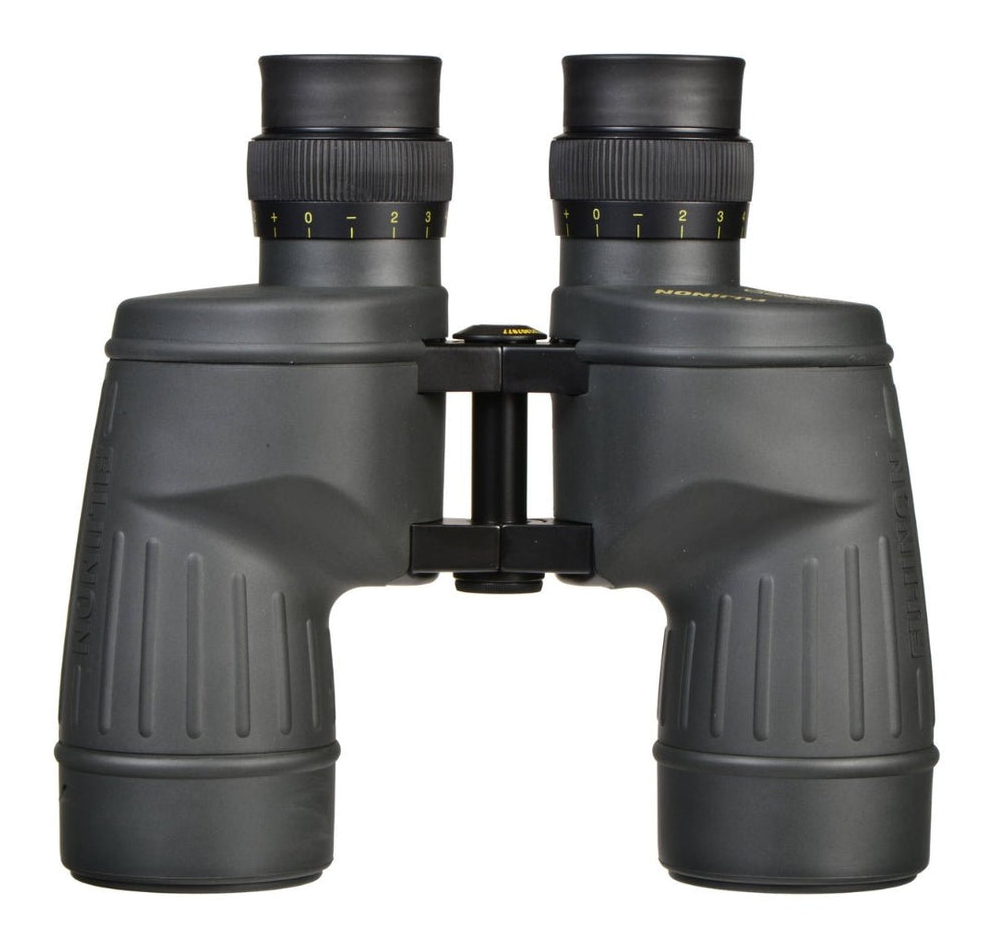
Quick take: The Fujinon Polaris 7x50 FMTR-SX costs $650 less; the Fujinon Techno-Stabi TS-X 14x40 reaches farther (14x vs 7x); the Fujinon Polaris 7x50 FMTR-SX has a wider field of view (383 vs 210 ft @ 1000 yds).
Field of view, to scale
Top-down view · drawn to true scale — no exaggeration
Which one to buy
On a moving boat the real choice is between more magnification and more forgiveness. The Fujinon Polaris 7x50 FMTR-SX takes the classic route: 7x, a 7.1mm exit pupil, 383 ft at 1000 yards and 23mm of eye relief, so the view stays bright and easy to find on a rolling deck and works with glasses. Owners treat it as the reference marine binocular, citing lab-measured light transmission near 98% and sharpness nearly to the edge. Individual eyepiece focusing means you set it once and leave it, because depth of field covers everything from roughly 10 meters out.
The Fujinon Techno-Stabi TS-X 14x40 costs $650 more and does something no conventional glass can. Its stabilizer corrects up to 6 degrees of motion, so 14x stays usable handheld from a boat. Owners and reviewers call it the best stabilization they've tested, and the steadied view resolves distant detail the 7x50 can't. You pay in light and comfort: measured transmission is about 73.5%, the exit pupil is 2.86mm, and reviewers measured effective eye relief around 7mm, close to unusable with glasses. It whirrs when the stabilizer engages, runs on four AAs, and owners say stabilization sags as they fade.
Weight is a wash at 47 oz against 48.2, and both are tiring on a neck strap. For general boating, night watches and astronomy, the Polaris is the better buy as well as the cheaper one, and far brighter at dusk. The TS-X earns its premium when the job is identifying a distant vessel, mark or bird in daylight from a moving platform, and your eyes work without glasses.
Fujinon Techno-Stabi TS-X 14x40
Worth the premium for identifying distant targets from a moving boat in daylight, as long as you don't need glasses; nothing else here steadies 14x like it.
Fujinon Polaris 7x50 FMTR-SX
The better all-round marine binocular for most boaters: brighter at dusk, glasses-friendly, no batteries, and $650 less.
| Spec | Fujinon Techno-Stabi TS-X 14x40 | Fujinon Polaris 7x50 FMTR-SX |
|---|---|---|
| Approx. price | ~$1,500 | ~$850 |
| Use case | Marine | Marine |
| Magnification | 14x | 7x |
| Objective | 40mm | 50mm |
| Exit pupil | 2.86mm | 7.1mm |
| Field of view | 210 ft @ 1000 yds | 383 ft @ 1000 yds |
| Eye relief | 13mm | 23mm |
| Close focus | 16.4 ft | 29 ft |
| Prism | Porro | Porro |
| Glass | BaK-4 | BaK-4 |
| Coating | Fully Multi-Coated | Fully Multi-Coated |
| Weight | 47 oz | 48.2 oz |
| Dimensions | 7.1 x 6.5 in | 8.5 x 7.8 in |
| Warranty | 10-Year Limited | 10-Year Limited |
Feature comparison
Fujinon Techno-Stabi TS-X 14x40
- ✗ED Glass
- ✗Phase-Corrected
- ✗Dielectric Coating
- ✓Waterproof
- ✓Fogproof
- ✓Image Stabilized
- ✗Tripod Adaptable
- ✗Magnesium Body
- ✗Locking Diopter
Fujinon Polaris 7x50 FMTR-SX
- ✗ED Glass
- ✗Phase-Corrected
- ✗Dielectric Coating
- ✓Waterproof
- ✓Fogproof
- ✗Image Stabilized
- ✓Tripod Adaptable
- ✗Magnesium Body
- ✗Locking Diopter
What birders say
Fujinon Techno-Stabi TS-X 14x40
- ✓Class-leading +/-6 degree stabilization range - the widest correction angle on the market, and one veteran reviewer flatly called it 'the best stabilisation I've tested'
- ✓Gimbaled-prism system is silent in operation and soaks up even boat-deck motion, which is why it's a marine-observation standard
- ✓Steadied 14x resolves detail no conventional handheld can - testers repeatedly identify distant birds, aircraft, and lunar features that defeat unstabilized glass
- ✓Lab testing found chromatic aberration minimal and astigmatism correction excellent - notably less false color than Canon's stabilized competitors
- ✓Sharpness holds nearly to the field edge, unusual for a stabilized design
- ✓Mil-spec Japanese internal construction described as 'super-rugged,' with water resistance and enough buoyancy provisions for life on deck
- ✓Runs on four AA batteries - easy to feed anywhere in the world, no proprietary packs
- ✓Astronomy owners are effusive - 'Magic!' is a representative first-light reaction - and it costs roughly a third of Swarovski's stabilized-size 14x52 NL alternative
- ✗Measured light transmission of just ~73.5% - well below conventional binoculars at this price, a real cost of the stabilization optics
- ✗Tiny 2.8mm exit pupil plus that transmission makes it weak at dawn, dusk, and under dark skies
- ✗Very heavy at 47 oz, with an odd ovoid shape that's uncomfortable for smaller hands and no fun on a neck strap
- ✗Effective eye relief measured around 7mm despite the 13mm claim - close to unusable with glasses
- ✗Narrow 210 ft field of view makes initially finding your target at 14x a genuine skill
- ✗Stiff focus wheel and fiddly diopter that are difficult to operate with gloves
- ✗Emits a high-pitched whirr when stabilization engages and disengages - lab reviewers called it annoying and potentially wildlife-disturbing
- ✗Lab testers noted truncated exit pupils, and stabilization performance sags as the four AAs fade - carry spares
Fujinon Polaris 7x50 FMTR-SX
- ✓Astonishing measured light transmission — independent lab testing recorded 97.9%, and reviewers describe 'supreme daytime brightness' that outperforms even modern premium 8x42s
- ✓Sharp nearly edge to edge with imperceptible distortion — lab tests found blur onset only at 93% of field radius, exceptional for any binocular, let alone a porro at this price
- ✓True mil-spec build: heavy aluminum body, thick rubber armor, nitrogen purge, internal desiccant, fully waterproof — the reference marine binocular for professional captains and serious sailors
- ✓Huge 7.1mm exit pupil and 7x magnification make a bright, steady view from a rocking deck and use a fully dark-adapted eye for astronomy
- ✓23mm eye relief is among the most generous anywhere — eyeglass and sunglass wearers see the whole field
- ✓Massive depth of field (roughly 10m to infinity) means almost no refocusing — ideal on the water and for tracking birds
- ✓Legendary longevity: astronomy-forum owners report examples bought in the early 1990s still delighting them — one recent thread is literally titled 'Wow!'
- ✓Named a best high-end marine binocular by review sites and backed by a limited lifetime warranty; lab reviewers recommended it 'wholeheartedly' as one of the best values on the market
- ✗Heavy — roughly 1.4-1.6kg (over 3 lbs), tiring to handhold for long sessions and a serious neck-strap load
- ✗Individual eyepiece focusing: perfect for marine and astronomy use, but slow and awkward for terrestrial subjects at changing distances — this is not a birding binocular
- ✗Close focus is a distant 4.3-5m minimum — anything nearby is simply out of reach
- ✗Despite the 'field flattener' branding, testers found astigmatism in the outer 10% of the field and some edge distortion
- ✗Chromatic aberration is low centrally but rises to medium at the field edges
- ✗Stray light and flare can intrude when a bright source sits near the field edge
- ✗Lab testing noted slightly truncated exit pupils — a minor blemish on an otherwise superb optical system
- ✗Big and bulky to pack; the 7x50 porro format is the opposite of travel-friendly
Fujinon Techno-Stabi TS-X 14x40 vs Fujinon Polaris 7x50 FMTR-SX: common questions
Is the Fujinon TS-X 14x40 worth $650 more than the Polaris 7x50 FMTR-SX for boating?▾
Only if magnification is the job. The TS-X's stabilizer makes 14x usable from a moving deck, and owners call it the best stabilization they've tested. For general navigation, night watches and quick scans, the Polaris's brighter 7x view and long eye relief suit most boaters better for less money.
Which is better at night, the TS-X 14x40 or the Polaris 7x50 FMTR-SX?▾
The Polaris, by a wide margin. Its 7.1mm exit pupil and transmission measured near 98% use everything a dark-adapted eye can take in, while the TS-X's 2.86mm exit pupil and roughly 73.5% transmission make it weak at dusk and under dark skies. The TS-X only pulls ahead on bright targets like the Moon.
Can I use the Fujinon TS-X 14x40 or the Polaris 7x50 with glasses?▾
The Polaris, easily: its 23mm eye relief is among the most generous anywhere, and owners say glasses wearers see the whole field. The TS-X is rated at 13mm, but reviewers measured closer to 7mm in practice, which they describe as close to unusable with glasses.