Athlon Argos G2 HD 8x42 vs Celestron Nature DX ED 10x42
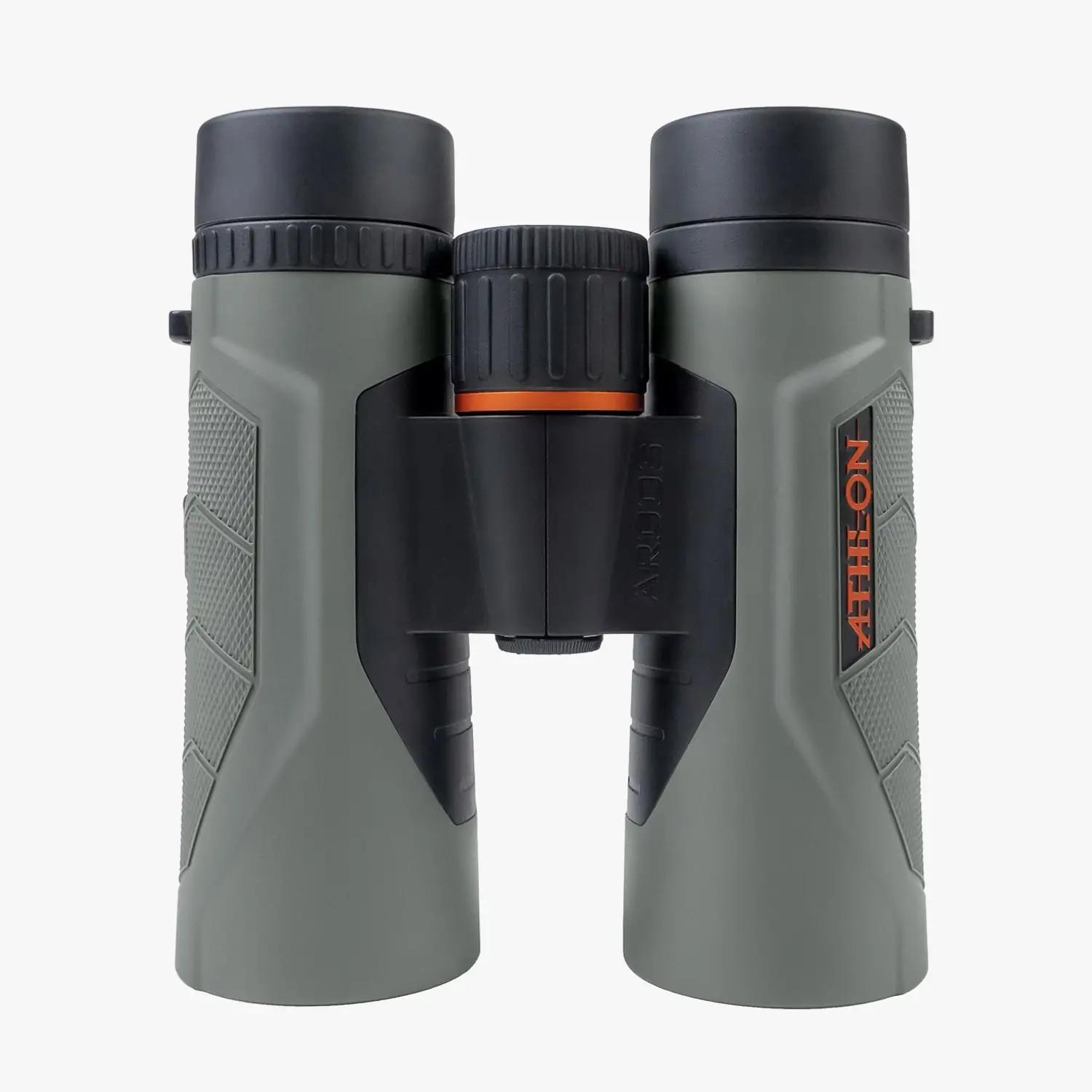
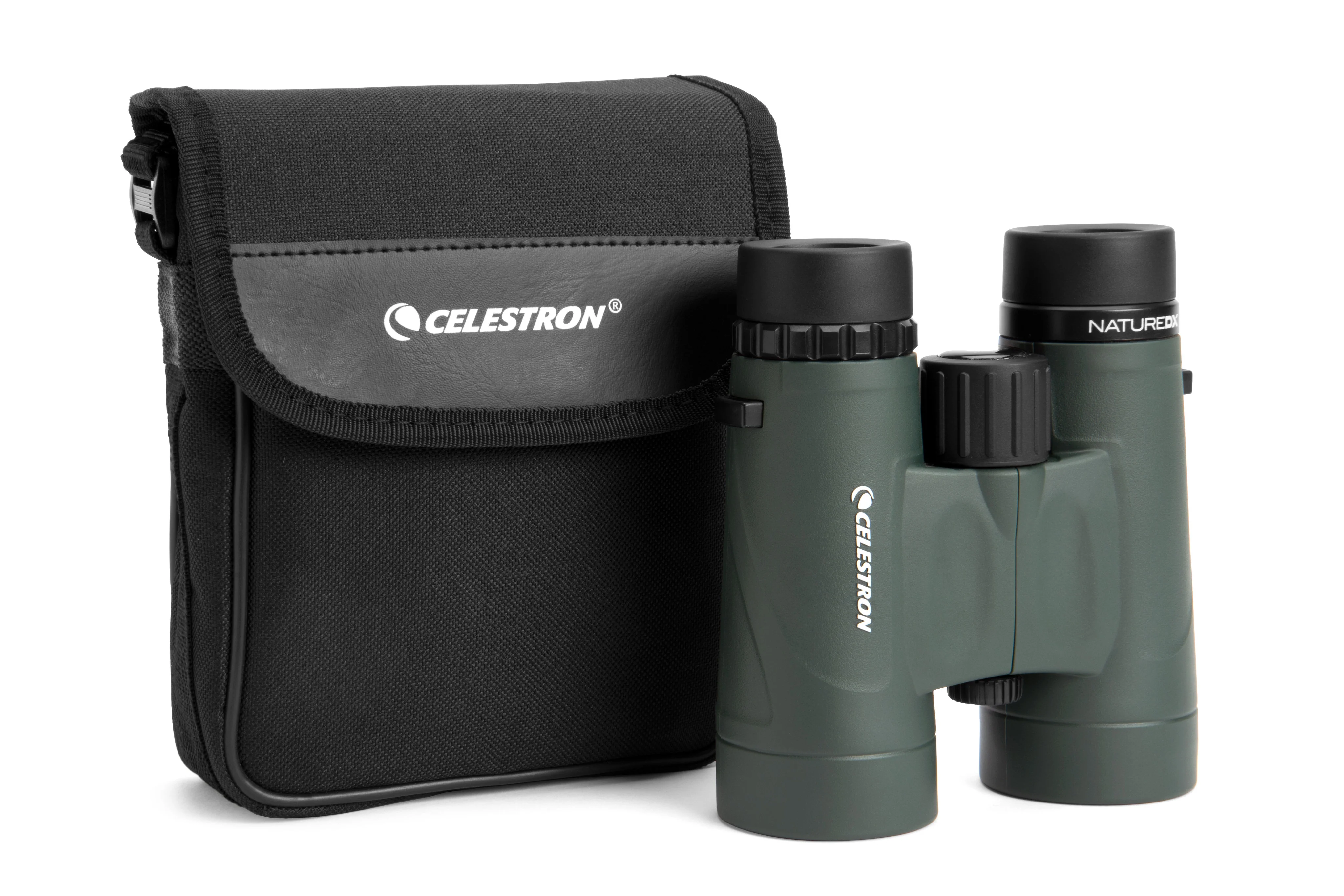
Quick take: The Athlon Argos G2 HD 8x42 costs $15 less; the Celestron Nature DX ED 10x42 reaches farther (10x vs 8x); the Athlon Argos G2 HD 8x42 has a wider field of view (371 vs 309 ft @ 1000 yds).
Field of view, to scale
Top-down view · drawn to true scale — no exaggeration
Which one to buy
Eye relief settles this for a lot of people before anything else does. The Celestron Nature DX ED 10x42 has 14.3mm, and its owners say eyeglass wearers get a clipped, vignetted view; the Athlon Argos G2 HD 8x42 offers 17.3mm, and most glasses wearers see the full field with the eyecups down. If you wear glasses, the Argos is the answer and the rest is detail.
For everyone else it is a choice between glass and handling, with $15 between them. The Celestron has true ED glass, which matters more at 10x because fringing grows with magnification, and owners say it keeps high-contrast edges clean. Its 6.5 ft close focus beats the Argos's rated 13 ft, though Argos owners report theirs focuses down to roughly 8 feet in practice. Where the Celestron falls down is in use: owners describe narrow, hard eyecups that collapse, a sluggish focus wheel that is more irritating at 10x, and a 309 ft field that makes finding birds slow.
The Argos lacks ED glass, and owners notice green/red fringing on dark subjects as the light drops. But the image is bright and true-color nearly to the edge, the focus wheel is smooth, and its 371 ft field at 8x is far easier to work in the woods. It also carries Athlon's Lifetime warranty against Celestron's Limited Lifetime, and owners of both treat Athlon's coverage as the stronger one. The plasticky housing and slipping lens covers are its main irritations.
For most buyers, first-time birders especially, the Argos is the better binocular to live with. The Celestron makes sense for someone without glasses who wants reach for open-country wildlife or casual stargazing and values clean edges over comfort.
Athlon Argos G2 HD 8x42
For glasses wearers and first-time birders, this is the easier binocular to live with: longer eye relief, a wider view and a stronger warranty for $15 less.
Celestron Nature DX ED 10x42
Worth a look only if you don't wear glasses and want ED glass with 10x reach for open country, accepting fussy eyecups and a slow focus wheel.
| Spec | Athlon Argos G2 HD 8x42 | Celestron Nature DX ED 10x42 |
|---|---|---|
| Approx. price | ~$225 | ~$240 |
| Use case | General Purpose | General Purpose |
| Magnification | 8x | 10x |
| Objective | 42mm | 42mm |
| Exit pupil | 5.25mm | 4.2mm |
| Field of view | 371 ft @ 1000 yds | 309 ft @ 1000 yds |
| Eye relief | 17.3mm | 14.3mm |
| Close focus | 13 ft | 6.5 ft |
| Prism | Roof | Roof |
| Glass | HD | ED |
| Coating | Fully Multi-Coated | Fully Multi-Coated |
| Weight | 25.5 oz | 24.9 oz |
| Dimensions | 5.5 x 5.0 in | 5.5 x 5.0 in |
| Warranty | Lifetime | Limited Lifetime |
Feature comparison
Athlon Argos G2 HD 8x42
- ✗ED Glass
- ✓Phase-Corrected
- ✓Dielectric Coating
- ✓Waterproof
- ✓Fogproof
- ✗Image Stabilized
- ✓Tripod Adaptable
- ✗Magnesium Body
- ✗Locking Diopter
Celestron Nature DX ED 10x42
- ✓ED Glass
- ✓Phase-Corrected
- ✗Dielectric Coating
- ✓Waterproof
- ✓Fogproof
- ✗Image Stabilized
- ✓Tripod Adaptable
- ✗Magnesium Body
- ✗Locking Diopter
What birders say
Athlon Argos G2 HD 8x42
- ✓Cornell's All About Birds testers rated it a 'Solid Choice,' praising a bright, true-color image that stays clear virtually to the edges — unusual at this price
- ✓No distortion or fishbowl effect when panning, so scanning a treeline or shoreline feels natural rather than warpy
- ✓Focus wheel is smooth and easy to work with — a specific callout from expert testers, not a given in the sub-$200 class
- ✓Lighter and smaller than the average 8x42 (around 23 oz measured), comfortable for all-day neck carry
- ✓Close focus performs way better than the printed spec — testers measured roughly 8 feet against a listed 13, making casual butterfly and feeder watching viable
- ✓Owners who also run Vortex, Nikon, and Leupold glass report the edge clarity and chromatic aberration control hang with pairs costing considerably more
- ✓Phase-corrected BaK-4 prisms with dielectric coatings — a spec sheet you normally see a tier up in price
- ✓Athlon's no-questions lifetime warranty comes up constantly in owner reviews as the tiebreaker over similarly priced competitors
- ✗Testers noted minor color fringing — a subtle green/red outline on darker objects — in lower light
- ✗The housing feels plasticky, and expert reviewers flagged long-term durability as an open question
- ✗Eyecups have a looser feel than pricier binoculars, and some hunters on forums found them too thick to get comfortable behind
- ✗Objective lens covers use stiff, slightly oversized attachment rings that slip off in the field
- ✗Included neck strap is padded but runs short
- ✗Forum consensus puts the optics between a Vortex Crossfire and a Diamondback — solid, but a step below true mid-tier glass
- ✗Brightness fades at dawn and dusk sooner than ED-glass rivals like the Celestron Nature DX ED or Athlon's own Midas line
- ✗Athlon sells both HD and UHD versions of the Argos G2 with near-identical names, and retailer listings frequently mix up the specs
Celestron Nature DX ED 10x42
- ✓Cheapest mainstream path to ED glass at 10x — frequently street-priced at or below the 8x42, making it a standout deal on paper
- ✓Same optical package Cornell's testers rated a 'Solid Choice' in the line: sharp, contrasty, with accurate colorful rendering in good light
- ✓ED elements keep fringing under control at 10x, where chromatic aberration is normally more visible than at 8x
- ✓One test lab said the line's BAK-4 optics rival models costing more than twice as much
- ✓About 25 ounces, typical for a full-size 10x42
- ✓Fully waterproof, nitrogen purged, and phase-coated — the complete feature checklist under $200
- ✓6.5-foot close focus is excellent for a 10x binocular
- ✓Extra reach makes it a flexible budget choice for open-country wildlife, travel, and casual astronomy
- ✗14.3mm of eye relief is the dealbreaker spec — eyeglass wearers consistently report clipped, vignetted views, a steep drop from the 8x42's 17.8mm
- ✗309-foot field of view is narrow, and at 10x that makes finding and tracking birds noticeably harder for beginners
- ✗Same widely criticized eyecups as the rest of the line — narrow, hard, loose, and prone to collapsing
- ✗Sluggish focus wheel that takes effort to start and stop precisely — more annoying at 10x where focus depth is shallower
- ✗4.2mm exit pupil plus budget coatings means dusk performance falls off faster than the 8x42's
- ✗Backlit subjects lose fine detail, per expert testing of the line
- ✗Polycarbonate chassis, budget rubber armor, and hinges that reviewers rate below sturdier mid-tier rivals
- ✗Basic unpadded webbing strap and lightly padded case continue the line's weak accessory story
Athlon Argos G2 HD 8x42 vs Celestron Nature DX ED 10x42: common questions
Can I use the Celestron Nature DX ED 10x42 with glasses, or should I get the Argos G2 HD 8x42?▾
Celestron owners consistently report a clipped field at 14.3mm of eye relief, even with the eyecups retracted. The Argos's 17.3mm lets most glasses wearers see the whole view, so it is the safer choice if you wear them.
Does the ED glass in the Nature DX ED 10x42 beat the Argos G2 HD 8x42 optically?▾
On fringing, yes. The ED elements keep color fringing under control at 10x, while Argos owners see subtle green/red outlines on dark objects in low light. The Argos counters with a wider field and a bright image that stays clear nearly to the edge, so image quality alone does not settle it.
Which has the better warranty, the Argos G2 HD 8x42 or the Nature DX ED 10x42?▾
Athlon's is a Lifetime warranty, and owners describe it as unconditional and transferable with no receipt needed. Celestron's is a Limited Lifetime warranty. Owners comparing the two brands lean toward Athlon partly for that reason.