Vortex Diamondback HD 8x42 vs Celestron Nature DX ED 8x42
Field of view, to scale
Top-down view · drawn to true scale — no exaggeration
Which one to buy
Price, field of view and exit pupil all match: $230, 393 ft, 5.25mm. The split is glass against body. The Celestron Nature DX ED 8x42 has ED glass, which the Vortex Diamondback HD 8x42 does not, and the Vortex has the better mechanics, warranty and accessories.
The Celestron's optics win praise. Expert testers found the image very sharp with good contrast and accurate color, and owners say it pulls out subtle field marks that budget glass smears. Diamondback owners, by comparison, report visible chromatic aberration on birds against bright sky and edges that soften in the outer 15% of the field. The Celestron also has a little more eye relief, 17.8mm against 17mm, and both work well for glasses.
Where the Celestron loses is everything you touch. Its owners' most repeated complaint is the eyecups: narrow, hard against the face, loose in their travel and prone to collapsing under pressure. The focus wheel is sluggish, the strap is unpadded webbing, the armor feels lower-grade, and detail suffers on backlit birds. The Diamondback is lighter at 21.8 oz against 24.9 oz, focuses to 5 ft against 6.5 ft, and ships with the GlassPak harness. Its owners have their own complaints, chiefly a stiff hinge, shallow depth of focus and focus wheels that vary from unit to unit, but none as constant as the Celestron's eyecups. Then there is the VIP warranty, unconditional and transferable, against Celestron's limited lifetime one. For a careful birder who mostly looks in daylight and cares most about color fringing, the Celestron's glass is the draw. For anyone who uses a binocular hard, shares it or wants it to last, the Diamondback is the safer $230.
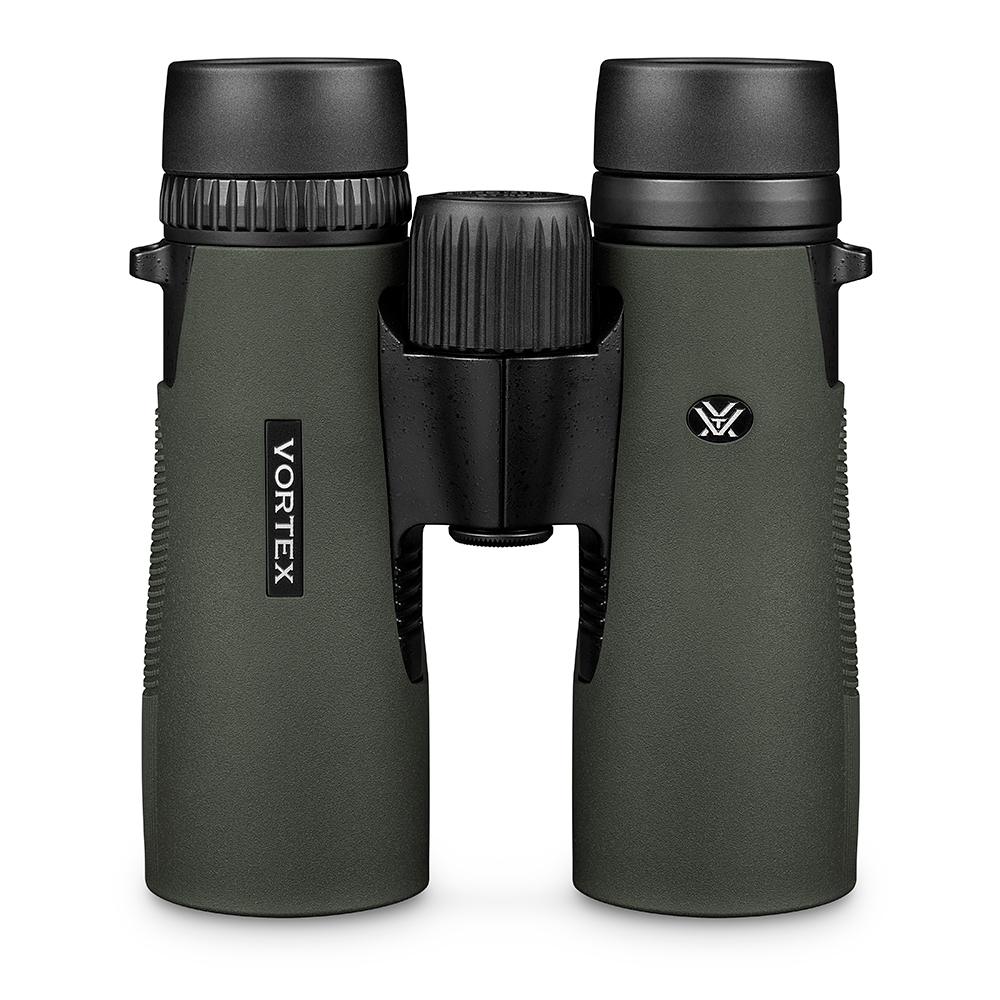
Vortex Diamondback HD 8x42
For birders and hunters who handle their binocular hard: better eyecups and focus feel, a lighter body, the GlassPak harness and an unconditional warranty.
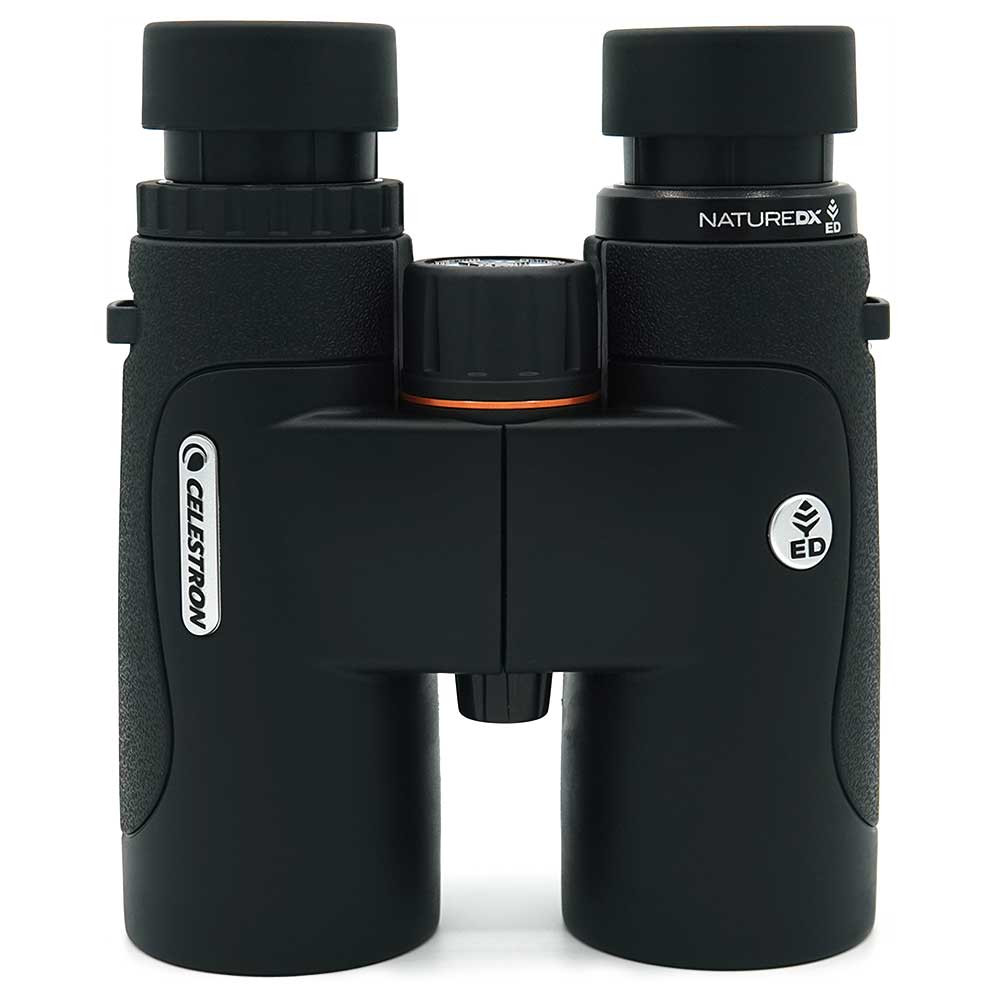
Celestron Nature DX ED 8x42
Best if image quality per dollar comes first and you can live with soft, collapsing eyecups: its ED glass controls color fringing better than the Vortex.
| Spec | Vortex Diamondback HD 8x42 | Celestron Nature DX ED 8x42 |
|---|---|---|
| Approx. price | ~$230 | ~$230 |
| Use case | Birding | Birding |
| Magnification | 8x | 8x |
| Objective | 42mm | 42mm |
| Exit pupil | 5.25mm | 5.25mm |
| Field of view | 393 ft @ 1000 yds | 393 ft @ 1000 yds |
| Eye relief | 17mm | 17.8mm |
| Close focus | 5 ft | 6.5 ft |
| Prism | Roof | Roof |
| Glass | HD | ED |
| Coating | Fully Multi-Coated | Fully Multi-Coated |
| Weight | 21.8 oz | 24.9 oz |
| Dimensions | 5.4 x 5.1 in | 5.6 x 5.0 in |
| Warranty | Lifetime (VIP) | Limited Lifetime |
Feature comparison
Vortex Diamondback HD 8x42
- ✗ED Glass
- ✓Phase-Corrected
- ✓Dielectric Coating
- ✓Waterproof
- ✓Fogproof
- ✗Image Stabilized
- ✓Tripod Adaptable
- ✗Magnesium Body
- ✗Locking Diopter
Celestron Nature DX ED 8x42
- ✓ED Glass
- ✓Phase-Corrected
- ✗Dielectric Coating
- ✓Waterproof
- ✓Fogproof
- ✗Image Stabilized
- ✓Tripod Adaptable
- ✗Magnesium Body
- ✗Locking Diopter
What birders say
Vortex Diamondback HD 8x42
- ✓The default 'first real binocular' recommendation on birding and hunting forums - owners consistently say it punches at the level of glass costing $100 more
- ✓Unusually wide 393-foot field of view for the class, noticeably wider than a Nikon Monarch M5 - beginners find birds faster and lose them less
- ✓Bright, contrasty center-field image; in side-by-sides owners call it a smidge brighter and more immersive than the Monarch M5
- ✓Vortex VIP warranty is unlimited, transferable, and no-receipt - forum lore is full of stories of trashed pairs replaced free, no questions asked
- ✓Included GlassPak chest harness is genuinely good and something competitors don't bundle at this price
- ✓Comfortable 17mm eye relief with solid click-stop eyecups works well for eyeglass wearers
- ✓Grippy rubber armor and IPX7-rated waterproof/fogproof build shrugs off rain, dust, and truck-cab abuse
- ✓Close focus around 5 feet makes it a legitimate butterfly and dragonfly binocular too
- ✗Edges soften noticeably in the outer 15% of the field - fine for centered subjects, but panning landscapes shows the blur
- ✗Visible chromatic aberration on high-contrast subjects like birds against bright sky
- ✗Shallow depth of focus means more focus-wheel fiddling than some rivals - a recurring gripe in Monarch comparisons
- ✗Focus wheel feel varies by unit; some owners report gritty or unevenly tensioned wheels out of the box
- ✗The center hinge is stiff enough that adjusting interpupillary distance 'puts up a fight'
- ✗Low-light performance trails the Viper HD by a clear margin - dawn and dusk glassing is where the price gap shows
- ✗At about 21.8 ounces it's not heavy, and slightly lighter than a Monarch M5 8x42 (22.2 oz)
- ✗Some glare and veiling flare when the sun is just outside the field of view
Celestron Nature DX ED 8x42
- ✓One of the cheapest routes to genuine ED glass — the standard forum answer to 'best binocular under $200' alongside the Vortex Crossfire HD
- ✓Cornell's All About Birds testers rated it a 'Solid Choice,' describing a very sharp image with good contrast and colorful, accurate rendering
- ✓Resolved subtle field marks in testing — warm yellow throat and fine contrasts on a Northern Parula — the kind of detail budget glass usually smears
- ✓BAK-4 prisms and optics that one test lab said rival models costing more than twice as much
- ✓Wide-ish 393-foot field of view and 17.8mm of eye relief — one of the most eyeglass-friendly budget binoculars around
- ✓Close focus measured around 7.6 feet in independent testing, fine for butterflies and feeder birds
- ✓Lighter than the average 8x42 despite the ED upgrade
- ✓Waterproof, nitrogen purged, and phase-coated — the full checklist at a price where corners usually get cut
- ✗Eyecups are the recurring complaint: testers found them narrow, hard against the eye, very loose in action, and prone to collapsing under pressure
- ✗Focus wheel described as sluggish — takes effort to get moving and to stop exactly where you want
- ✗Detail visibly suffers in backlit conditions; testers struggled with fine markings on backlit warblers
- ✗Low-light performance still trails mid-tier glass — one lab measured it noticeably dimmer than premium competitors at dusk
- ✗Unergonomic balance point and average construction feel noted by reviewers, with hinges less sturdy than higher-end options
- ✗Rubber armor feels lower-grade than pricier models
- ✗Included neck strap is basic non-padded webbing that testers called uncomfortable
- ✗Some testers found the body a bit narrow for larger faces, adding to daily-use discomfort
Vortex Diamondback HD 8x42 vs Celestron Nature DX ED 8x42: common questions
Does the Celestron Nature DX ED 8x42 have better optics than the Vortex Diamondback HD 8x42?▾
It has ED glass and the Diamondback does not, and owners and testers praise its sharpness, contrast and accurate color. Diamondback owners report more visible color fringing on birds against bright sky. Both share the same 393 ft field and 5.25mm exit pupil.
Are the Nature DX ED 8x42 eyecups really a problem compared with the Diamondback HD?▾
Owners call them the single most repeated complaint: narrow, hard against the eye socket, loose and prone to collapsing. Glasses wearers notice it less because they keep the cups down anyway. Diamondback owners report solid click-stop eyecups, though a few say the intermediate stops are soft.
Which warranty is better, Vortex VIP on the Diamondback HD 8x42 or Celestron's on the Nature DX ED?▾
The Vortex VIP warranty is unconditional, transferable and needs no receipt, and owners tell many stories of damaged pairs replaced free. The Celestron carries a limited lifetime warranty instead. For someone rough on gear, that difference is a large part of the Diamondback's appeal.
Which is lighter to carry, the Diamondback HD 8x42 or the Nature DX ED 8x42?▾
The Diamondback, at 21.8 oz against 24.9 oz, and it includes the GlassPak chest harness. Celestron owners say the basic unpadded strap is uncomfortable and that a padded aftermarket strap is a common first upgrade.