Nikon Prostaff P3 8x42 vs Nikon Prostaff P3 10x42
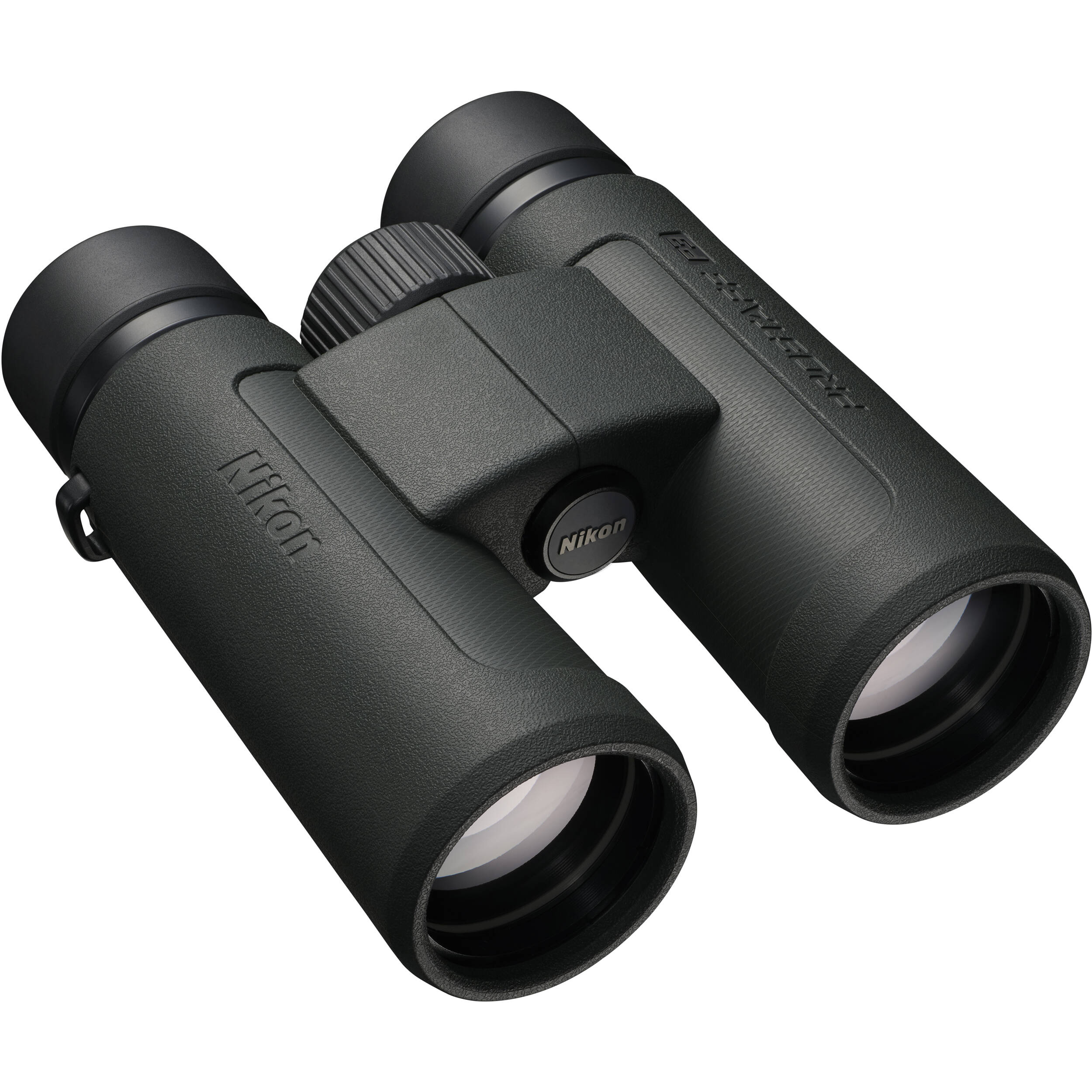
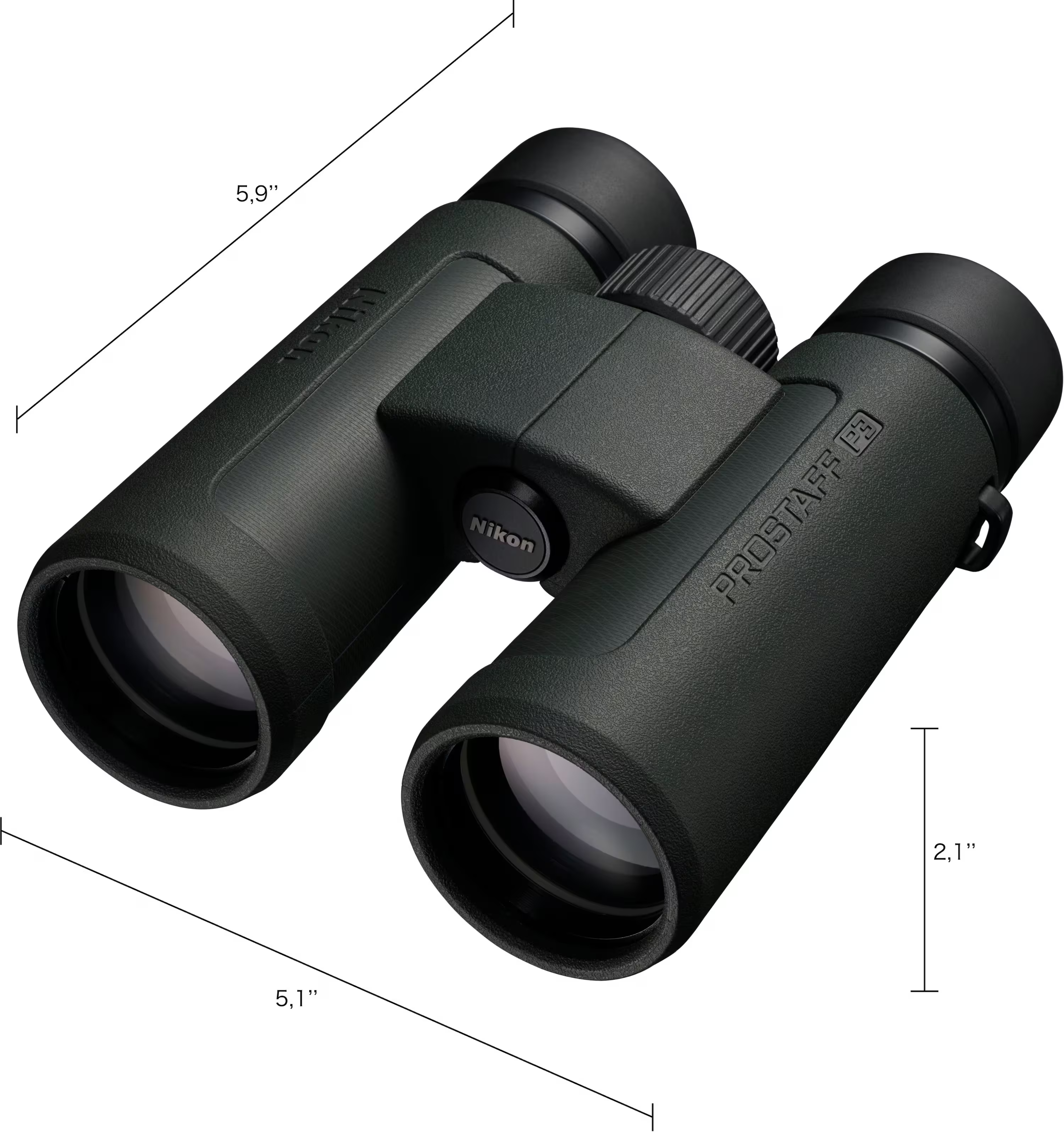
Quick take: The Nikon Prostaff P3 8x42 costs $10 less; the Nikon Prostaff P3 10x42 reaches farther (10x vs 8x); the Nikon Prostaff P3 8x42 has a wider field of view (377 vs 367 ft @ 1000 yds).
Field of view, to scale
Top-down view · drawn to true scale — no exaggeration
Which one to buy
Ten dollars and two steps of magnification separate these Prostaff P3s, and the cheaper one is the better binocular for most people. They share the same body, the same 9.8 ft close focus and the same coatings, and they weigh nearly the same at 20.3 oz and 20.6 oz. Both are waterproof, fogproof and tripod adaptable with the same limited lifetime warranty, so build gives you no reason to pick either.
Every real difference flows from the magnification. The 8x42 keeps a 5.25mm exit pupil against the 10x42's 4.2mm, so it stays brighter at dawn and dusk. Its field is slightly wider, 377 ft against 367 ft, and 10x42 owners say that small gap understates the real one, because 10x shake makes finding and following subjects harder. Eye relief is the sharpest split: 20.2mm on the 8x42, which owners rate among the most glasses-friendly budget binoculars, against 15.7mm on the 10x42, where glasses-wearing reviewers struggled to see the whole field.
Owner complaints overlap: fringing on high-contrast edges with no ED glass, soft edges, and a stiff focus out of the box. 10x42 owners also say it measures bright for its class and handles well, so it is a sound binocular, just a narrower one in purpose. It suits hunters and open-country viewers who don't wear glasses and want the extra reach, and even its own owners say most beginners are better served by the 8x42.
Nikon Prostaff P3 8x42
For birders, beginners and anyone in glasses: the wider, brighter, steadier view, and $10 cheaper.
Nikon Prostaff P3 10x42
Worth the extra $10 to hunters and open-country viewers who don't wear glasses and want 10x reach at the same weight.
| Spec | Nikon Prostaff P3 8x42 | Nikon Prostaff P3 10x42 |
|---|---|---|
| Approx. price | ~$160 | ~$170 |
| Use case | General Purpose | General Purpose |
| Magnification | 8x | 10x |
| Objective | 42mm | 42mm |
| Exit pupil | 5.25mm | 4.2mm |
| Field of view | 377 ft @ 1000 yds | 367 ft @ 1000 yds |
| Eye relief | 20.2mm | 15.7mm |
| Close focus | 9.8 ft | 9.8 ft |
| Prism | Roof | Roof |
| Glass | Standard | Standard |
| Coating | Fully Multi-Coated | Fully Multi-Coated |
| Weight | 20.3 oz | 20.6 oz |
| Dimensions | 5.7 x 5.1 in | 5.8 x 5.1 in |
| Warranty | Limited Lifetime | Limited Lifetime |
Feature comparison
Nikon Prostaff P3 8x42
- ✗ED Glass
- ✗Phase-Corrected
- ✗Dielectric Coating
- ✓Waterproof
- ✓Fogproof
- ✗Image Stabilized
- ✓Tripod Adaptable
- ✗Magnesium Body
- ✗Locking Diopter
Nikon Prostaff P3 10x42
- ✗ED Glass
- ✗Phase-Corrected
- ✗Dielectric Coating
- ✓Waterproof
- ✓Fogproof
- ✗Image Stabilized
- ✓Tripod Adaptable
- ✗Magnesium Body
- ✗Locking Diopter
What birders say
Nikon Prostaff P3 8x42
- ✓Class-leading on-axis sharpness - forum reviewers call it probably the sharpest roof prism you can buy near $100
- ✓Remarkably lightweight for a full-size 42mm roof - one of the lightest phase-coated 8x42s made, great for all-day carry
- ✓Generous 20mm+ eye relief with click-stop eyecups makes it one of the most eyeglass-friendly budget binoculars available
- ✓Fully waterproof and nitrogen-purged fogproof - a huge step over porro-prism rivals like the Aculon A211 at similar money
- ✓Wide 7.2-degree field of view, unusually generous for a budget roof and a clear upgrade over the old Prostaff 3s
- ✓Phase-corrected prisms at a price point where many competitors skip them - contrast and resolution punch above the price
- ✓Comfortable, grippy rubber armor and a simple, snag-free body that owners describe as 'disappearing in the hand'
- ✓Widely regarded on forums as a significant optical improvement over its Prostaff 3s predecessor for barely more money
- ✗Silver-coated (not dielectric) prisms mean the image is a touch dimmer than the Prostaff P7 or Monarch M5 - noticeable at dusk
- ✗No ED glass, so chromatic aberration shows as color fringing on backlit birds and high-contrast edges
- ✗Accessories are bare-bones: unpadded webbing strap, a foam pouch, and lens covers that don't attach and famously get lost
- ✗Edge sharpness falls off in the outer portion of the field - fine for spotting, less fine for panning landscapes
- ✗Some eyeglass wearers report slight vignetting at certain eyecup positions - worth testing before the return window closes
- ✗Focus wheel is functional but not luxurious; a few owners describe slight stiffness in cold weather
- ✗Close focus is unremarkable, so butterfly and dragonfly watchers often look elsewhere
- ✗Plastic-heavy chassis keeps weight down but doesn't feel as substantial as the Monarch M5's build
Nikon Prostaff P3 10x42
- ✓Genuinely bright for the price - independent lab testing measured light transmission well above similarly priced 10x42 competitors, and owners describe the view as 'crisp for the price' more often than any other compliment
- ✓Comfortable, well-balanced handling - at around 21 ounces with grippy rubber armor and a slimmer frame than most full-size binoculars, reviewers single out the ergonomics as a strength in this class
- ✓Real waterproofing and fogproofing at a $120 price point where many competitors only claim 'weather resistant'
- ✓Nikon's optical pedigree shows in the center of the image - fully multi-coated lenses give better sharpness in the middle of the field than most bargain-bin glass
- ✓Drop-resistant build that owners trust as a truck or backpack binocular they don't have to baby
- ✓Fully multi-coated optics at a price where some competitors still ship partially coated lenses
- ✓Tripod adaptable, which is unusual and welcome at this tier if you want steadier 10x views
- ✓Strong value reputation - it's regularly recommended on forums as a safe first binocular from a name brand, versus gambling on no-name imports
- ✗Visible chromatic aberration - reviewers note yellow and magenta color fringing on high-contrast subjects like birds against bright sky, which is where budget glass without ED elements shows its limits
- ✗No phase-corrected prisms - the P3 uses silver-coated prisms without phase correction, so contrast and resolution lag behind the Prostaff P7 and other step-up models
- ✗Eye relief around 15.7mm is tight for eyeglass wearers - glasses-wearing reviewers reported difficulty seeing the full field of view with this 10x42 version
- ✗Close focus of about 9.8 feet is long, ruling out butterflies, dragonflies, and close feeder birds
- ✗Focus knob is described as stiff out of the box and merely average after break-in - tracking fast-moving birds takes practice
- ✗The 367 ft field is nearly as wide as the 8x42's 377 ft, but 10x shake still makes finding and following subjects harder than with the 8x version
- ✗Noticeable softness and distortion toward the top and bottom edges of the image, per hands-on testing
- ✗Birders on forums note a real loss of contrast compared to mid-tier models - it's an entry point, not an endpoint, and many owners upgrade within a couple of years
Nikon Prostaff P3 8x42 vs Nikon Prostaff P3 10x42: common questions
Should glasses wearers choose the Prostaff P3 8x42 or the 10x42?▾
The 8x42. Its 20.2mm of eye relief lets most glasses wearers see the full field with the eyecups down, while reviewers wearing glasses had trouble taking in the whole field through the 10x42's 15.7mm.
Is the Prostaff P3 10x42 worth $10 more than the 8x42?▾
Only if you need the reach. For open-country hunting the extra magnification helps pick out distant game, but you give up exit pupil, eye relief and steadiness, and 10x42 owners themselves say most beginners do better with the 8x42.