Meopta MeoStar B1 Plus 10x42 vs Athlon Cronus G2 UHD 15x56
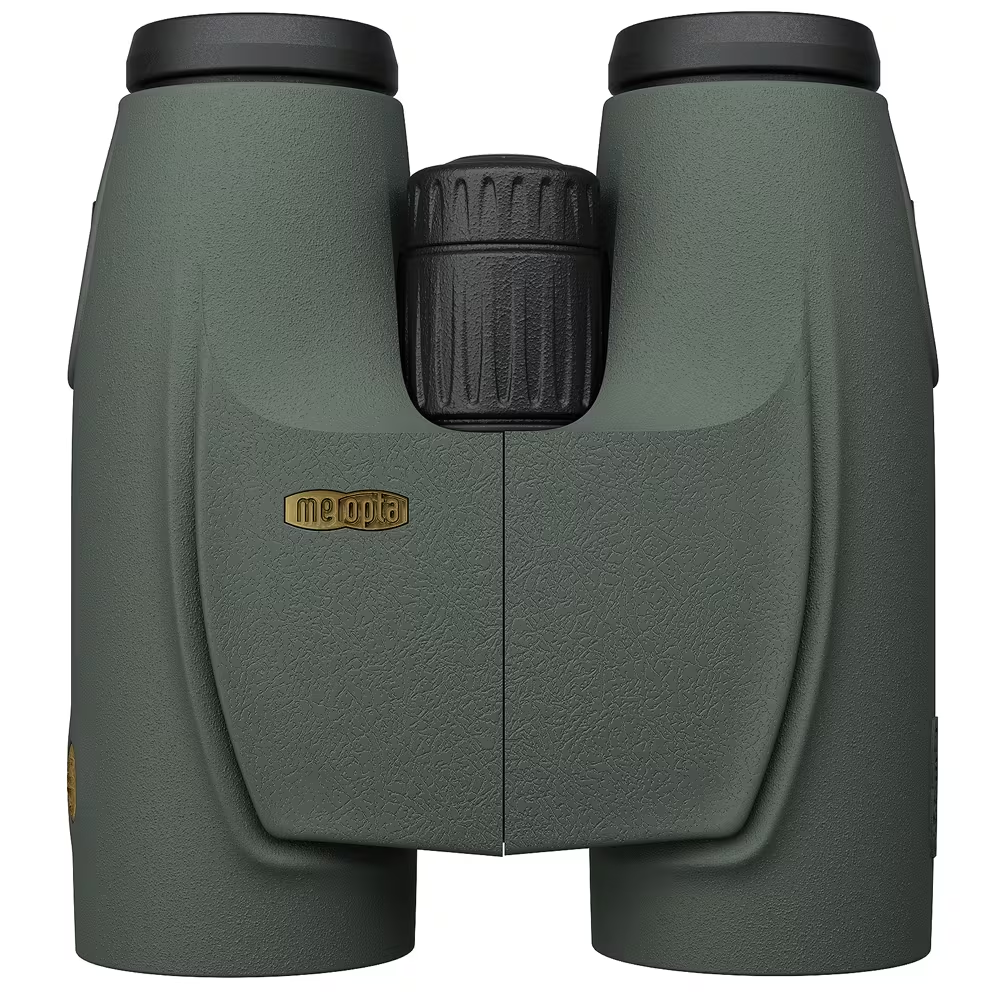
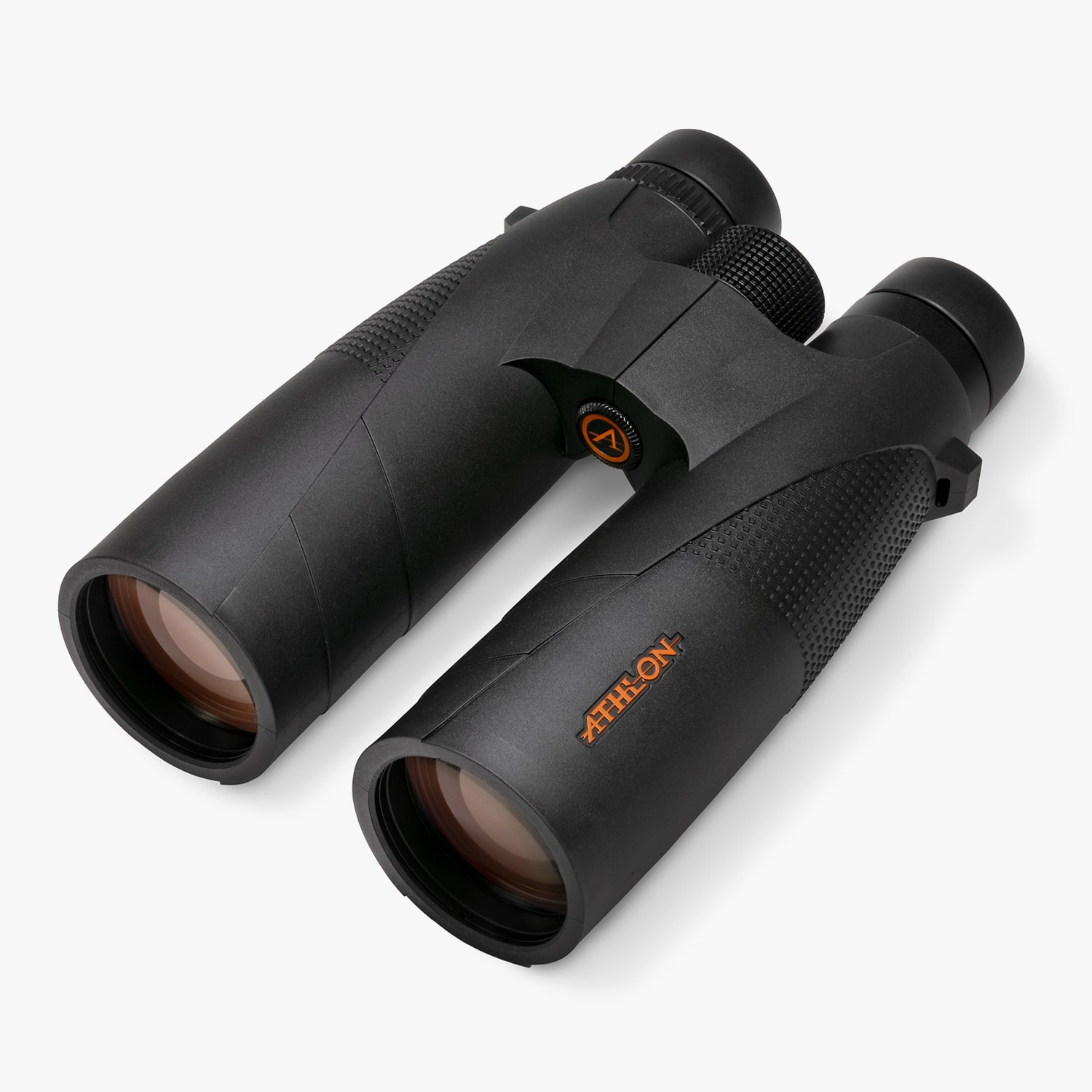
Quick take: The Meopta MeoStar B1 Plus 10x42 costs $50 less; the Athlon Cronus G2 UHD 15x56 reaches farther (15x vs 10x); the Meopta MeoStar B1 Plus 10x42 has a wider field of view (330 vs 235 ft @ 1000 yds).
Field of view, to scale
Top-down view · drawn to true scale — no exaggeration
Which one to buy
Owners of the Meopta MeoStar B1 Plus 10x42 like to say most people would not bother with a 15x once they have looked through it. The Athlon Cronus G2 UHD 15x56 exists for the people who would. At $50 apart, these are not rival versions of one binocular: one is a near-alpha 10x42 you carry all day, the other is a 45.2 oz tripod glass for gridding distant hillsides.
The Meopta's case is its glass and its handling. Owners describe alpha-level center sharpness and color at roughly half the price of the big European names, brightness that outclasses similarly priced rivals at dawn, a buttery focus wheel and a magnesium build reviewers rate as more solid than competing premium glass. Its weak points are 16mm of eye relief that deep-set eyes find tight, edges that soften, mild fringing in harsh backlight, and availability: it is discontinued and may be hard to find new.
The Athlon's case is magnification. Owners report a bright, color-neutral image with essentially no fringing on the moon's edge, field flatteners that work, and real resolving power on a tripod, plus 18.5mm of eye relief and a box that includes a hard case and tripod adapter. The cautions are sample variation, with one astronomy owner returning a unit with off-axis spherical aberration, a fast focus wheel and faster diopter that make critical focus fiddly, and a 3.7mm exit pupil that gives up the last minutes of light to a 10x42. Handheld, owners say it is usable only for brief braced checks.
For a single binocular you carry and use by hand, the Meopta is the far better choice if you can find one. The Athlon is a second instrument for western hunters who glass from a fixed spot and want 15x on a tripod without alpha prices.
Meopta MeoStar B1 Plus 10x42
For a carry-everywhere hunting binocular with near-alpha glass, it's the one to track down while stock lasts; it is discontinued.
Athlon Cronus G2 UHD 15x56
Best as dedicated tripod glass for long-range glassing or casual astronomy, alongside a lighter everyday binocular.
| Spec | Meopta MeoStar B1 Plus 10x42 | Athlon Cronus G2 UHD 15x56 |
|---|---|---|
| Approx. price | ~$800 | ~$850 |
| Use case | Hunting | Hunting |
| Magnification | 10x | 15x |
| Objective | 42mm | 56mm |
| Exit pupil | 4.2mm | 3.7mm |
| Field of view | 330 ft @ 1000 yds | 235 ft @ 1000 yds |
| Eye relief | 16mm | 18.5mm |
| Close focus | 6.6 ft | 13.1 ft |
| Prism | Roof | Roof |
| Glass | HD | UHD |
| Coating | Fully Multi-Coated | Fully Multi-Coated |
| Weight | 24.7 oz | 45.2 oz |
| Dimensions | 5.5 x 4.9 in | 8.7 x 6.2 in |
| Warranty | Limited Lifetime | Lifetime |
Feature comparison
Meopta MeoStar B1 Plus 10x42
- ✓ED Glass
- ✓Phase-Corrected
- ✓Dielectric Coating
- ✓Waterproof
- ✓Fogproof
- ✗Image Stabilized
- ✓Tripod Adaptable
- ✓Magnesium Body
- ✓Locking Diopter
Athlon Cronus G2 UHD 15x56
- ✓ED Glass
- ✓Phase-Corrected
- ✓Dielectric Coating
- ✓Waterproof
- ✓Fogproof
- ✗Image Stabilized
- ✓Tripod Adaptable
- ✓Magnesium Body
- ✓Locking Diopter
What birders say
Meopta MeoStar B1 Plus 10x42
- ✓Genuine near-alpha optics - reviewers repeatedly describe 'alpha-level optical performance at roughly half the price of Swarovski or Zeiss equivalents'
- ✓Long-range hunters report the brightness 'blows away' similarly priced competitors, with one review measuring usable dawn detail well ahead of rivals
- ✓Resolution good enough that owners say most people 'would not bother with the 15x' - it resolves distant detail beyond what its price suggests
- ✓The B1 Plus update adds a locking diopter, an extra eyecup position, revised lighter ergonomic armor, and MeoDrop hydrophobic lens coating over the already-loved B1
- ✓Buttery-smooth focus wheel with ideal resistance, usable with either hand and gloves
- ✓Made start-to-finish in Meopta's Czech factory, with the premium fluoride HD glass and MeoBright coatings the brand supplies to bigger names
- ✓Robust magnesium build that reviewers judge more solidly assembled than the Zeiss Conquest HD it competes with
- ✓Superb natural color rendition and contrast that owners consistently mention alongside far more expensive glass
- ✗Eye relief in the 15-16mm range is merely adequate - eyeglass wearers with deep-set eyes report clipping the field edges
- ✗Edge sharpness softens toward the periphery; it lacks the field-flattener polish of the true alphas it otherwise chases
- ✗Mild chromatic aberration appears in harsh high-contrast scenes, unlike the essentially CA-free flagship class
- ✗Meopta's US retail presence is thin, so most buyers purchase sight-unseen - and post-2024 distribution changes have made stock spottier
- ✗Eyecups can feel stiff out of the box, per multiple owner reports
- ✗Brand prestige and resale value trail Swarovski, Zeiss, and Leica despite competitive glass
- ✗Transmission, while excellent, still measures a step behind the Zeiss Conquest HD in independent comparisons
- ✗Slightly heavier in hand than the newest generation of premium 10x42s
Athlon Cronus G2 UHD 15x56
- ✓Near-premium glassing performance for hundreds less than alpha 15x56s - reviewers who've used binoculars costing twice as much say the clarity gap is small enough most users wouldn't notice without a side-by-side
- ✓UHD ED glass and 99%-reflective ESP dielectric prisms deliver a genuinely bright, color-neutral image - one astronomy owner found zero chromatic aberration on the moon's limb and Jupiter's disk
- ✓The E2ES field flatteners actually work - in a side-by-side against an APM MS 12x50 ED on the Orion Nebula, the Athlon showed the flatter field and more nebula glow, and that owner ended up selling the APM
- ✓Real resolving power on a tripod - an astronomy owner split the double star Mizar and pulled three stars out of the Trapezium, which translates directly to picking apart mule deer on distant ridges
- ✓Generous 18.5mm eye relief with twist-up eyecups - glasses wearers report seeing the full field with sharp field stops without hunting for position
- ✓Unusually complete accessory kit: a substantial padded hard case, soft case, tripod adapter, and multiple straps all in the box
- ✓Standard 1/4-20 tripod thread and a smooth focus wheel that covers close focus to infinity in about 1.5 turns
- ✓Athlon's no-questions lifetime warranty covers defects and damage, which matters on an optic that lives in a truck bed or pack
- ✗At 45.2 oz this is a tripod instrument, full stop - handheld 15x is only usable for brief braced checks, and owners who grip near the objectives for stability find the focus wheel out of reach
- ✗Sample variation is real: one astronomy owner returned a unit with off-axis spherical aberration that persisted at infinity, while other owners report clean units - inspect yours early
- ✗The focus wheel is fast and the diopter ring even faster, which made achieving critically sharp focus fiddly enough that one owner cited it as a return reason
- ✗Narrow 235 ft field of view at 1000 yards (4.5 degrees) - typical for 15x56 but you'll do more panning to find animals
- ✗Sweet spot estimates from owners range from about 60% to 85% of the field, with slight edge softening visible in high-contrast scenes like branches against bright sky
- ✗The 3.7mm exit pupil gives up low-light performance to an 8x42 or 10x42 in the last minutes of legal shooting light
- ✗A hunter who compared them directly to the Vortex Kaibab 15x56 put them in the same class but preferred the Kaibab's view
- ✗13.1 ft close focus and a fairly basic, thinly padded neck strap for such a heavy binocular
Meopta MeoStar B1 Plus 10x42 vs Athlon Cronus G2 UHD 15x56: common questions
Can the Athlon Cronus G2 UHD 15x56 replace a 10x42 like the Meopta MeoStar B1 Plus?▾
Not for most hunters. Athlon owners say the 45.2 oz binocular is a tripod instrument and handheld use is limited to brief braced checks. Its 235 ft field also makes finding animals slower than the Meopta's 330 ft.
Which is better for glasses, the Meopta MeoStar B1 Plus 10x42 or the Athlon Cronus G2 15x56?▾
The Athlon, with 18.5mm of eye relief that owners in glasses say shows the full field. Meopta owners call the B1 Plus's 16mm merely adequate, with deep-set eyes clipping the field edges.
Should I worry about sample variation on the Athlon Cronus G2 15x56 compared with the Meopta MeoStar B1 Plus?▾
It is worth checking. One Athlon owner returned a unit with off-axis spherical aberration while others report clean units, so test yours during the return window. Meopta owners report consistent optics, but the B1 Plus is discontinued and harder to find.