Meopta MeoPro HD 10x42 vs Meopta MeoStar B1 Plus 10x42
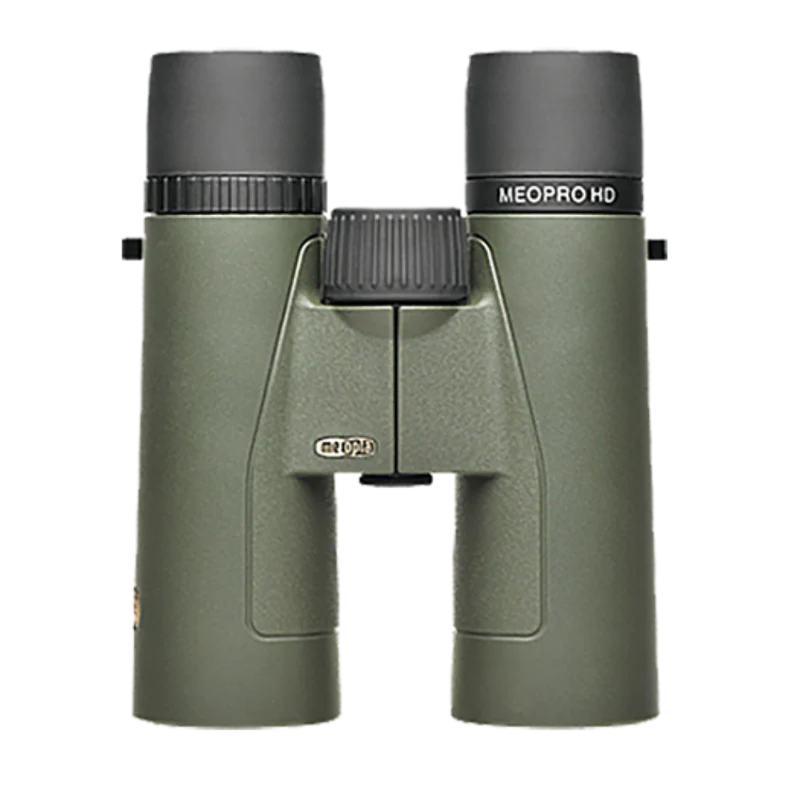
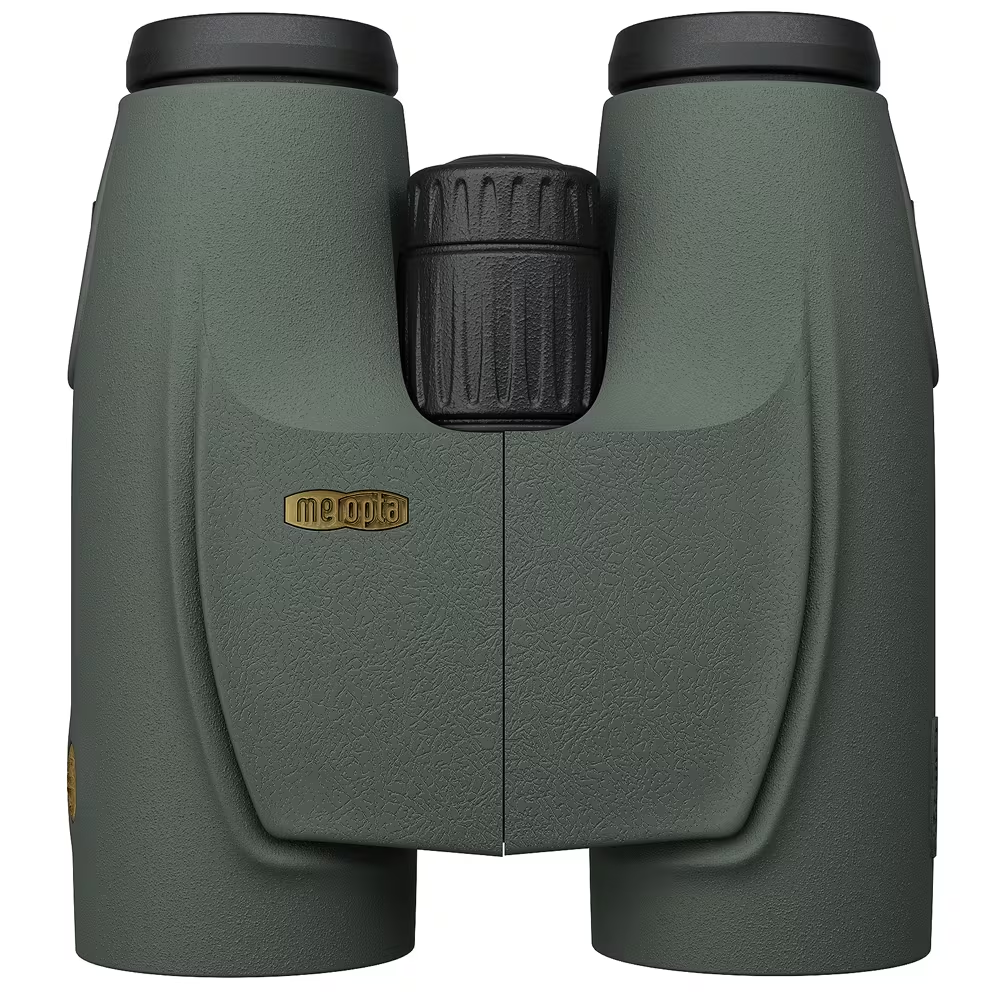
Quick take: The Meopta MeoPro HD 10x42 costs $350 less; the Meopta MeoPro HD 10x42 has a wider field of view (351 vs 330 ft @ 1000 yds).
Field of view, to scale
Top-down view · drawn to true scale — no exaggeration
Which one to buy
Neither Meopta is current, so whichever you choose, you are shopping remaining stock, and both may be hard to find new. That makes the decision partly about what you can locate. If both turn up, the question is whether the MeoStar B1 Plus 10x42's glass is worth $350 over the MeoPro HD 10x42.
Owners say it is, for low light especially. The B1 Plus is built entirely in Meopta's Czech factory, and reviewers keep describing alpha-level center sharpness, brightness and color at roughly half the price of the big European names. Long-range hunters report dawn detail well ahead of similarly priced rivals. The MeoPro's lab results are good in the center, with perfect distortion correction and a field wider than its 351 ft spec, but measured transmission around 83%, edge blur from around 66% of the way out, coma from mid-field, and interior damping that felt loose.
The cheaper binocular does win two things on paper: a wider field, 351 ft against the B1 Plus's 330 ft, and slightly more eye relief at 17mm against 16mm. B1 Plus owners call its eye relief merely adequate and say deep-set eyes clip the field edges, and they report stiff eyecups out of the box and mild color fringing in harsh backlight. In return, its focus wheel draws real praise, its locking diopter is confirmed by owners, and reviewers judge its magnesium build more solid than rival premium glass. MeoPro owners say its diopter does not lock.
For a hunter who glasses at first and last light and wants the closest thing to alpha glass at this money, the B1 Plus is worth tracking down. The MeoPro makes sense for daylight glassing on a tighter budget, where its strong center image does most of the work.
Meopta MeoPro HD 10x42
For daylight hunting on a budget, if you can still find one new, its sharp center image and wider field cover most needs for $350 less.
Meopta MeoStar B1 Plus 10x42
Worth the extra $350 for dawn-and-dusk hunters who want near-alpha brightness and build, while stock remains; it is discontinued.
| Spec | Meopta MeoPro HD 10x42 | Meopta MeoStar B1 Plus 10x42 |
|---|---|---|
| Approx. price | ~$450 | ~$800 |
| Use case | Hunting | Hunting |
| Magnification | 10x | 10x |
| Objective | 42mm | 42mm |
| Exit pupil | 4.2mm | 4.2mm |
| Field of view | 351 ft @ 1000 yds | 330 ft @ 1000 yds |
| Eye relief | 17mm | 16mm |
| Close focus | 6.6 ft | 6.6 ft |
| Prism | Roof | Roof |
| Glass | HD | HD |
| Coating | Fully Multi-Coated | Fully Multi-Coated |
| Weight | 24.4 oz | 24.7 oz |
| Dimensions | 5.6 x 5.0 in | 5.5 x 4.9 in |
| Warranty | Limited Lifetime | Limited Lifetime |
Feature comparison
Meopta MeoPro HD 10x42
- ✓ED Glass
- ✓Phase-Corrected
- ✓Dielectric Coating
- ✓Waterproof
- ✓Fogproof
- ✗Image Stabilized
- ✓Tripod Adaptable
- ✗Magnesium Body
- ✓Locking Diopter
Meopta MeoStar B1 Plus 10x42
- ✓ED Glass
- ✓Phase-Corrected
- ✓Dielectric Coating
- ✓Waterproof
- ✓Fogproof
- ✗Image Stabilized
- ✓Tripod Adaptable
- ✓Magnesium Body
- ✓Locking Diopter
What birders say
Meopta MeoPro HD 10x42
- ✓Chromatic aberration is sensibly corrected - only slight in the image center per independent lab testing, impressive for a 10x at this price
- ✓Field of view measured wider than the class average for a 10x42 - lab testers called it 'a big field of view for this class' and found it exceeds the spec sheet
- ✓Distortion correction earned a perfect score in independent optical testing - straight lines stay straight
- ✓Sharp from a genuinely close 4.3 feet, unusual among 10x42 hunting binoculars
- ✓Excellent color rendering with quality BaK-4 prisms and full multilayer coatings
- ✓Czech optical pedigree and rugged, nitrogen-purged magnesium build shared with the well-regarded 8x42 sibling
- ✓Astigmatism correction rated exceptional in lab review - stars and point sources stay tight
- ✓Solid value: delivers most of what the premium 10x42 class offers at a mid-tier price, backed by Meopta's lifetime transferable warranty for North America
- ✗Edge sharpness is the weak spot - independent testing found blur beginning around 66% of the way from center, a below-average result
- ✗Pronounced coma appears from mid-field outward, smearing point sources near the edges - a real drawback for astronomy use
- ✗Measured light transmission around 83% trails the premium class noticeably, costing brightness in the final minutes of dusk
- ✗The 4.2mm exit pupil dims quicker at dawn and dusk than the 8x42's - a consideration for low-light hunters
- ✗Lab reviewers noted the tubes' interior damping felt loose, with internal parts moving more easily than they should at this level
- ✗Diopter doesn't lock and eyecups offer limited click stops, same as the 8x42
- ✗Faces brutal competition around $450-500 from wide-field rivals like the Vortex Viper HD and discounted Zeiss Conquest HD
- ✗Thin dealer network makes hands-on comparison and resale harder than mainstream brands
Meopta MeoStar B1 Plus 10x42
- ✓Genuine near-alpha optics - reviewers repeatedly describe 'alpha-level optical performance at roughly half the price of Swarovski or Zeiss equivalents'
- ✓Long-range hunters report the brightness 'blows away' similarly priced competitors, with one review measuring usable dawn detail well ahead of rivals
- ✓Resolution good enough that owners say most people 'would not bother with the 15x' - it resolves distant detail beyond what its price suggests
- ✓The B1 Plus update adds a locking diopter, an extra eyecup position, revised lighter ergonomic armor, and MeoDrop hydrophobic lens coating over the already-loved B1
- ✓Buttery-smooth focus wheel with ideal resistance, usable with either hand and gloves
- ✓Made start-to-finish in Meopta's Czech factory, with the premium fluoride HD glass and MeoBright coatings the brand supplies to bigger names
- ✓Robust magnesium build that reviewers judge more solidly assembled than the Zeiss Conquest HD it competes with
- ✓Superb natural color rendition and contrast that owners consistently mention alongside far more expensive glass
- ✗Eye relief in the 15-16mm range is merely adequate - eyeglass wearers with deep-set eyes report clipping the field edges
- ✗Edge sharpness softens toward the periphery; it lacks the field-flattener polish of the true alphas it otherwise chases
- ✗Mild chromatic aberration appears in harsh high-contrast scenes, unlike the essentially CA-free flagship class
- ✗Meopta's US retail presence is thin, so most buyers purchase sight-unseen - and post-2024 distribution changes have made stock spottier
- ✗Eyecups can feel stiff out of the box, per multiple owner reports
- ✗Brand prestige and resale value trail Swarovski, Zeiss, and Leica despite competitive glass
- ✗Transmission, while excellent, still measures a step behind the Zeiss Conquest HD in independent comparisons
- ✗Slightly heavier in hand than the newest generation of premium 10x42s
Meopta MeoPro HD 10x42 vs Meopta MeoStar B1 Plus 10x42: common questions
Is the Meopta MeoStar B1 Plus 10x42 noticeably brighter than the MeoPro HD 10x42?▾
Owners say so. B1 Plus owners report brightness that outclasses similarly priced binoculars and dawn detail well ahead of rivals. MeoPro testing measured transmission around 83%, which costs brightness in the final minutes of dusk, even though both share a 4.2mm exit pupil.
Are both the Meopta MeoPro HD 10x42 and MeoStar B1 Plus 10x42 discontinued?▾
Yes, both are discontinued, so new units may be hard to find. B1 Plus owners also note that changes to Meopta's US distribution have made stock spottier, and most buyers purchase without trying one first.
Which is better for eyeglass wearers, the MeoPro HD 10x42 or the MeoStar B1 Plus 10x42?▾
Neither is ideal. The MeoPro offers 17mm and the B1 Plus 16mm, and B1 Plus owners call its eye relief merely adequate, with deep-set eyes clipping the field edges. Glasses wearers should test before buying where possible.