Celestron Nature DX 8x42 vs Celestron Nature DX 10x42
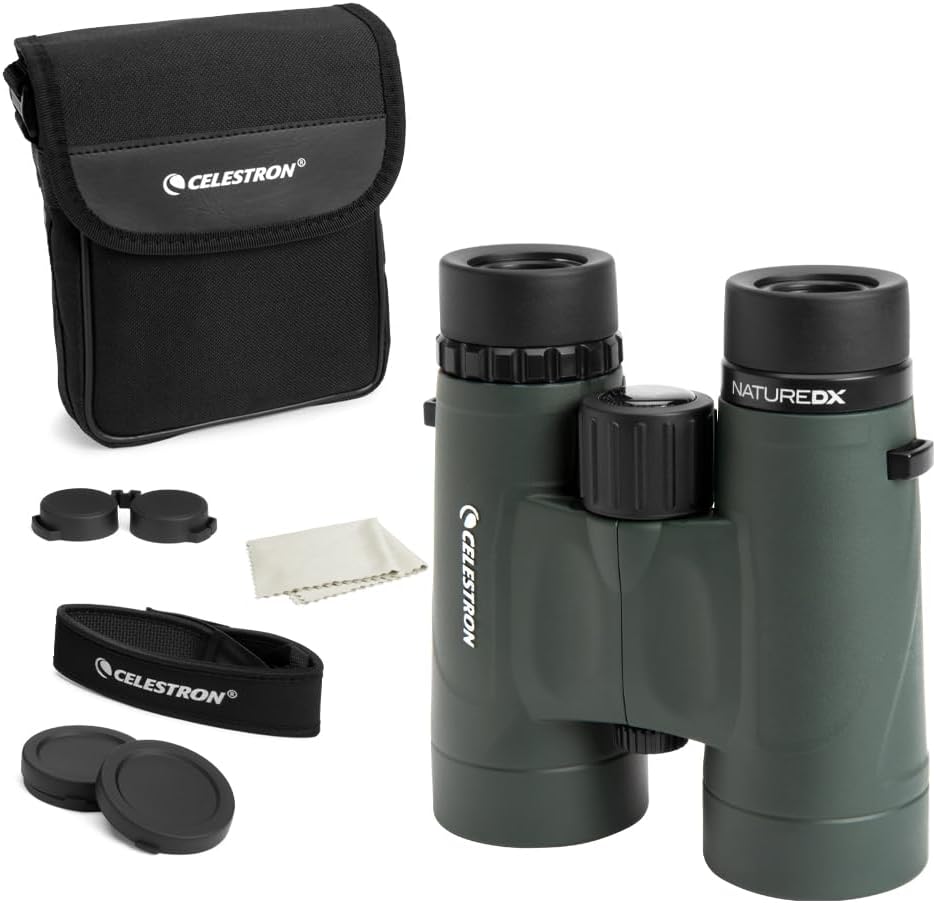
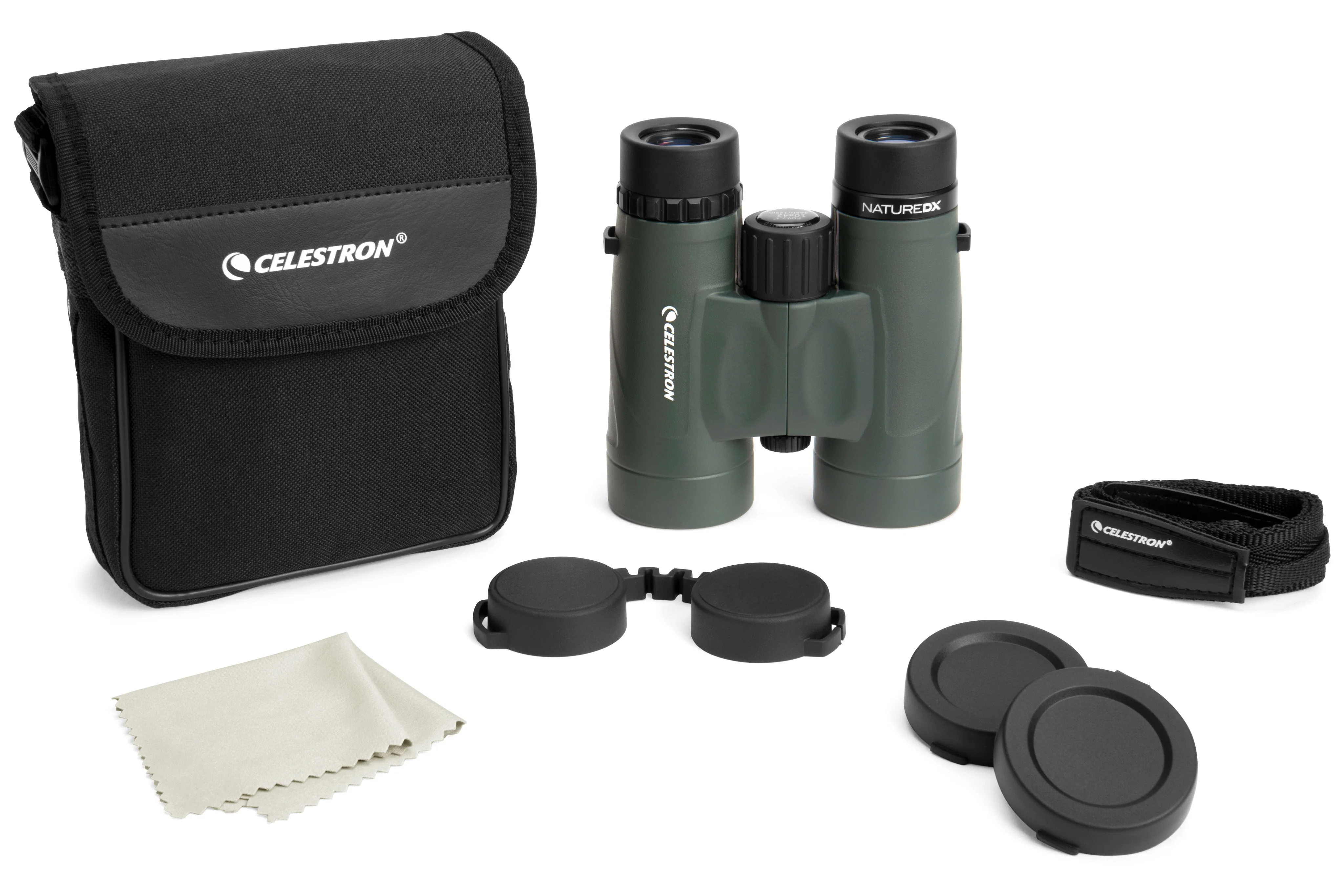
Quick take: The Celestron Nature DX 8x42 costs $8 less; the Celestron Nature DX 10x42 reaches farther (10x vs 8x); the Celestron Nature DX 8x42 has a wider field of view (388 vs 304 ft @ 1000 yds).
Field of view, to scale
Top-down view · drawn to true scale — no exaggeration
Which one to buy
Each Nature DX has a signature complaint, and they point to different buyers. Owners of the Celestron Nature DX 8x42 talk about kidney-bean blackouts, dark crescents from imprecise eye placement that most learn to avoid within a week by adjusting the eyecups. Owners of the Celestron Nature DX 10x42 talk about 14mm of eye relief that costs glasses wearers the outer field. The first is a learning curve; the second is a hard limit.
That makes the 8x42 the safer buy for most people, at $8 less. It shows 388 ft against 304 ft, has 17.5mm of eye relief, and a 5.25mm exit pupil against 4.2mm, so it is easier to find birds with and brighter at dusk. Its owners call it the most recommended first birding binocular around and praise its close focus for butterflies and feeder birds, though they note soft edges, ordinary fringing and a diopter that is easy to knock.
The 10x42's case is reach and weight, 22.2 oz against 24.9 oz, with natural color and a precise low-geared focus that owners like. The two share 6.5 ft close focus, waterproofing and phase-corrected prisms. For beginners, birders and anyone in glasses, the 8x42 is the right choice, and owners of each say so. The 10x42's narrower view only pays off in open country.
Celestron Nature DX 8x42
The default first binocular for beginners, birders, butterfly watchers and anyone in glasses, at $8 less.
Celestron Nature DX 10x42
Worth it only for open-country viewing, stadiums or travel, and only if you don't wear glasses.
| Spec | Celestron Nature DX 8x42 | Celestron Nature DX 10x42 |
|---|---|---|
| Approx. price | ~$149 | ~$157 |
| Use case | Birding | General Purpose |
| Magnification | 8x | 10x |
| Objective | 42mm | 42mm |
| Exit pupil | 5.25mm | 4.2mm |
| Field of view | 388 ft @ 1000 yds | 304 ft @ 1000 yds |
| Eye relief | 17.5mm | 14mm |
| Close focus | 6.5 ft | 6.5 ft |
| Prism | Roof | Roof |
| Glass | Standard | Standard |
| Coating | Fully Multi-Coated | Fully Multi-Coated |
| Weight | 24.9 oz | 22.2 oz |
| Dimensions | 5.3 x 5.0 in | 5.5 x 5.0 in |
| Warranty | Limited Lifetime | Limited Lifetime |
Feature comparison
Celestron Nature DX 8x42
- ✗ED Glass
- ✓Phase-Corrected
- ✗Dielectric Coating
- ✓Waterproof
- ✓Fogproof
- ✗Image Stabilized
- ✓Tripod Adaptable
- ✗Magnesium Body
- ✗Locking Diopter
Celestron Nature DX 10x42
- ✗ED Glass
- ✓Phase-Corrected
- ✗Dielectric Coating
- ✓Waterproof
- ✓Fogproof
- ✗Image Stabilized
- ✓Tripod Adaptable
- ✗Magnesium Body
- ✗Locking Diopter
What birders say
Celestron Nature DX 8x42
- ✓The most-recommended first birding binocular on forums for years - a huge owner base and near-universal 'best under $110' status
- ✓Outstanding 6.5-foot close focus - butterfly, dragonfly, and feeder watchers pick it over everything else at the price
- ✓Phase-coated BaK-4 prisms and fully multi-coated optics, specs that used to cost twice as much
- ✓Genuinely waterproof and nitrogen-purged - owners report years of wet-weather use without fogging
- ✓Wide, comfortable 7.4-degree field of view that makes finding and tracking birds easy for beginners
- ✓Compact, lightweight body with grippy armor that suits smaller hands better than porro rivals like the Aculon A211
- ✓Pleasing, slightly warm color rendition many owners prefer for birding
- ✓Backed by Celestron's limited lifetime warranty and a massive community of long-term owners for support
- ✗Kidney-bean blackouts are the signature complaint - eye placement is fussy until you learn the sweet spot
- ✗Not as bright as the best budget roofs at dawn and dusk - the Nikon Prostaff P3 edges it in low light
- ✗Edge softness is obvious in the outer 25-30% of the field
- ✗Chromatic aberration shows on high-contrast subjects; the ED version exists for a reason
- ✗Focus wheel on some units feels stiff or slightly uneven out of the box
- ✗Included case and strap are flimsy, and the case isn't waterproof even though the binocular is
- ✗Diopter adjustment is unlockable and easy to knock out of position
- ✗Occasional sample variation and collimation issues reported - buy from a retailer with easy returns
Celestron Nature DX 10x42
- ✓The default 'best cheap binocular' answer on birding forums — the Nature DX line is probably the most-recommended sub-$150 full-size binocular anywhere
- ✓Expert reviewers rate the line as one of the best values in its class, with build quality that 'looks and feels far more expensive than it actually is'
- ✓Colors render natural without artificial tints, and fringing is minimal unless you deliberately hunt for it at high-contrast edges
- ✓Phase-corrected BaK-4 prisms and fully multi-coated optics — features that were $300-binocular territory not long ago
- ✓Compact for a full-size 42mm at about 25 ounces, with finger indents and textured thumb areas that reviewers praise
- ✓Soft twist-up eyecups with an intermediate stop work smoothly, and the low-geared focus wheel allows precise fine-tuning even in gloves
- ✓Fully waterproof and nitrogen purged at a price where those features often get faked
- ✓6.5-foot close focus is genuinely good for casual butterfly and feeder viewing
- ✗Just 14mm of eye relief on the 10x42 — eyeglass wearers widely report vignetting and lost field, and it's the single biggest reason forum users steer glasses wearers to the 8x42 instead
- ✗304-foot field of view is narrow, making birds in flight and small fast passerines harder to find and track at 10x
- ✗Standard (non-ED) glass shows its limits in dim light — detail fades at dawn and dusk faster than the ED version or pricier rivals
- ✗4.2mm exit pupil dims the image earlier in the evening than the 8x42's
- ✗Polycarbonate chassis and no diopter lock — the diopter can drift, and scale markings are minimal
- ✗Included neck strap is thin and unpadded, and the soft case is lightly padded at best
- ✗Shallow objective lens recession offers less protection from rain and stray light than deeper-set designs
- ✗The 720-degree low-geared focus takes a lot of turning to run from close focus to infinity — precise, but slow when a bird pops up at a different distance
Celestron Nature DX 8x42 vs Celestron Nature DX 10x42: common questions
Should a beginner choose the Celestron Nature DX 8x42 or the 10x42?▾
The 8x42, almost always. Owners of each say its wider 388 ft field, better eye relief and brighter dusk image matter more to a new user than extra magnification, and it costs $8 less.
Are the kidney-bean blackouts on the Nature DX 8x42 worse than the 10x42's eye relief problem?▾
They are easier to fix. 8x42 owners say most people eliminate the blackouts within days by adjusting eyecup height and eye position. The 10x42's 14mm of eye relief is fixed, so glasses wearers keep losing the outer field.